
Every growing business eventually faces the same question: Should we build our team with in-house employees or rely on manpower supply services?
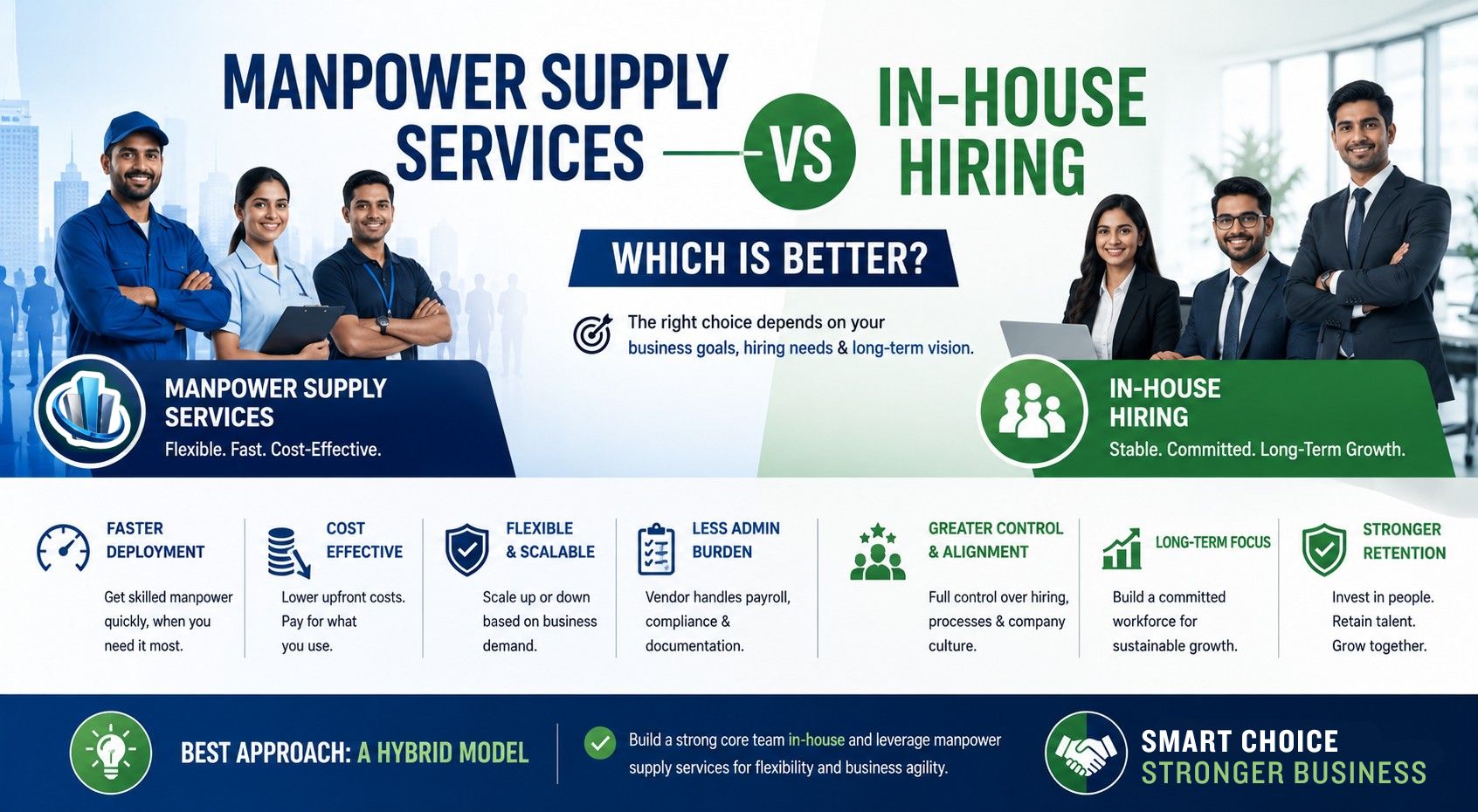
Both models can work extremely well, but they are suited to different situations. The right choice depends on your cost structure, the type of roles you need, how quickly you must hire, and how important long-term culture is for you.
In-house hiring usually wins for core, long-term strategic roles, while manpower supply services are excellent for operational, project-based, or fluctuating workforce needs.
What Are Manpower Supply Services?
Manpower supply services (or staffing services) are third-party agencies that recruit, screen, and deploy workers to your company on a contract basis. Legally, these workers are employed by the agency, not by your business directly.
The provider typically manages sourcing, documentation, payroll, statutory compliance, and sometimes even training. You focus on getting the work done, while the agency handles most HR operations in the background.
What Is In-House Hiring?
In-house hiring means your company recruits and employs people directly on its own payroll. Your HR team is responsible for job postings, interviews, selection, joining formalities, payroll, and performance management.
This model gives you full control over who joins your team, how they grow, and how closely they are aligned with your company’s values and culture.
Side-by-Side Comparison
| Factor | Manpower Supply Services | In-House Hiring |
|---|---|---|
| Flexibility & Scalability | Easy to scale up or down quickly based on projects or seasons. | Workforce is relatively fixed; changes take more time and planning. |
| Cost Structure | Lower upfront HR cost; pay a service fee but save on recruitment, training, and benefits. | Higher fixed cost when you include salary, benefits, recruitment time, and training. |
| Speed of Hiring | Agency can deploy pre-screened candidates quickly, often within days. | Internal hiring cycles can take weeks due to sourcing, interviews, and approvals. |
| Control & Culture | Less direct control over HR policies and long-term development of staff. | High control over culture, performance standards, and career paths. |
| Compliance & Risk | Agency handles most labour law, documentation, and statutory compliance. | Company carries full responsibility for legal and compliance obligations. |
| Best For | Operational, repetitive, or project-based roles with fluctuating demand. | Core strategic roles that need strong loyalty and deep business knowledge. |
Pros and Cons of Manpower Supply Services
Advantages
- High flexibility: You can ramp your workforce up or down without long notice periods or complex exit processes.
- Faster hiring: Agencies maintain a ready pool of candidates, which cuts down your time-to-fill dramatically.
- Lower HR workload: Your internal HR team spends less time on bulk hiring, documentation, and payroll.
- Access to wider talent: Good agencies have large networks and can find workers you might not reach directly.
- Better cost control for non-core work: You pay for the manpower you actually use, which is ideal for short-term or seasonal work.
Limitations
- Weaker culture and loyalty: Contract staff may feel less attached to your brand and more to the agency.
- Quality depends on the agency: If the provider cuts corners in screening, your performance can suffer.
- Less direct control: You have to coordinate changes in policies, replacements, or shifts through the provider.
Pros and Cons of In-House Hiring
Advantages
- Stronger culture and ownership: Direct employees are more likely to stay longer, absorb your values, and show higher loyalty.
- Better quality of hire for core roles: Your internal team understands your business deeply and can select candidates who fit both skills and attitude.
- Long-term capability building: You can invest in training, multi-skilling, and leadership development over years.
- Direct control: You can directly manage performance, incentives, and growth plans without a middle layer.
Limitations
- Higher total cost: When you add benefits, training, HR overhead, and infrastructure, in-house employees can cost 1.25–1.4 times their salary.
- Slower to scale: Expanding or shrinking the team takes more time and can involve difficult decisions.
- Heavy HR workload: Sourcing, interviews, onboarding, and compliance all sit on your internal team’s shoulders.
So, Which Is Better?
There is no one-size-fits-all winner. The better option depends on the type of work, your growth stage, and how predictable your demand is.
- Choose in-house hiring when the role is core to your business, directly impacts customers or strategy, and you want to build long-term knowledge and loyalty.
- Choose manpower supply services when the work is operational, project-based, seasonal, or when you want to reduce HR overhead and speed up hiring without long-term headcount commitments.
In reality, many successful companies adopt a hybrid model: a strong in-house core team combined with an outsourced flexible layer for non-core, high-volume, or variable tasks.
How to Decide for Your Business
To make a clear decision, ask yourself:
- Is this role strategic and long-term, or operational and temporary?
- Can my cash flow support higher fixed headcount costs?
- How quickly do I need to hire and deploy people on the ground?
- Do I have a strong internal HR team, or would an external partner add more value?
If most answers point to flexibility, speed, and reduced HR burden, manpower supply services are likely a better fit. If the answers highlight culture, control, and long-term growth, in-house hiring should be your priority.
Frequently Asked Questions
Manpower deployment means assigning the right employees to the right tasks. It is important because it improves efficiency, reduces workload imbalance, and ensures smooth operations.
Manpower mobilization means preparing and sending workers to the project site. A mobilization plan includes selecting manpower, scheduling, arranging resources, and ensuring workers are ready for deployment.
Manpower deployed refers to workers who are already assigned and actively working on a project or task.
Organizations can deploy manpower better by analyzing workload, assigning skills-based tasks, using workforce planning tools, and avoiding underutilization or overstaffing.
Yes — real-time attendance data automatically syncs with payroll modules, improving accuracy and compliance with Indian labour laws.
Absolutely. Most modern HRM software solutions in India are scalable and modular. Small businesses can start with core HR and payroll features and later add advanced modules such as performance management, recruitment, training, and analytics as their workforce and operational needs expand.
Yes, payroll outsourcing is completely legal in India as long as statutory requirements like PF, ESI, TDS, and labor laws are followed correctly.
Yes — the revamped ECR 2.0 system (launched September 2025) includes a revision window for correcting inadvertent errors under certain conditions, a first-time feature for employers.