-
EDP Services is a leading HR outsourcing and recruitment partner offering end-to-end solutions including payroll, compliance, skill development, and talent acquisition—backed by 29+ years of industry experience.
-
EDP Services caters to a wide range of organizations including startups, SMEs, large enterprises, across sectors like IT, manufacturing, BFSI, retail, logistics, and more
-
It’s a secure, web-based platform that enables remote management of HR functions like payroll, recruitment, onboarding, and compliance—accessible 24/7 from any device.
-
- Easy access anytime, anywhere
- Real-time data and analytics
- Automated processes (e.g. salary slips, leave tracking)
- High-level data security & backups
- Scalable for growing teams
-
- Payroll processing
- Statutory compliance (PF, ESI, PT, etc.)
- Recruitment & onboarding
- Employee record management
- Performance tracking
- Exit formalities
-
EDP reduces internal HR workload, ensures legal compliance, improves operational efficiency, and lowers overhead costs—while providing expert HR guidance.
-
EDP’s approach is strategic—focusing on workforce planning, long-term skill alignment, employer branding, and proactive candidate pipelines.
-
EDP recruits across sectors like:
- Information Technology
- Healthcare
- Manufacturing
- Retail
- Logistics & Supply Chain
- BFSI
- Education & more
-
- Monthly salary processing
- Payslip generation
- Income tax calculations
- Bonus & incentive tracking
- Full & final settlements
-
- Provident Fund (PF)
- Employee State Insurance (ESI)
- Professional Tax (PT)
- Labour Welfare Fund (LWF)
- Shops & Establishment Act compliance
Including monthly returns and audits.
-
EDP provides structured training programs in technical, managerial, and soft skills—delivered by experienced corporate trainers and industry mentors.
-
Yes, programs are tailored to meet specific client needs and can be delivered in-person or online.
-
- Needs analysis
- Customized modules
- Post-training evaluation
- Certification (where applicable)
-
Yes. The cloud-based platform uses encryption, role-based access control, and regular backups to ensure maximum data privacy and security.
-
Absolutely. EDP offers dedicated customer support, regular updates, and training for HR teams and employees.
-
You can fill out the contact form on https://www.edps.in or reach out directly via phone/email. A consultant will schedule a discovery call to understand your needs.
-
Yes, EDP Services offers product demos and initial consultations free of cost.
-
Pricing depends on the services chosen, number of employees, and customization level. Packages are flexible and cost-effective for both small and large organizations.
-
After initial consultation, EDP’s team sets up your organization profile, imports employee data (via Excel/CSV), configures payroll rules, tax slabs, attendance policies, and compliance parameters. You’ll receive admin credentials to access the portal.
-
You’ll need to upload or input employee data like PAN, Aadhaar, bank details, joining date, salary components, leave balance, designation, etc. EDP provides templates for bulk upload.
-
Yes. Admins are given live walkthroughs, help docs, and optionally recorded sessions to ensure they’re confident in using the system.
-
The system calculates monthly pay by integrating attendance, leave, tax deductions, reimbursements, and bonuses. Auto-generated payslips, TDS, and statutory forms are downloadable in bulk.
-
Yes, the app allows you to configure fixed and variable salary heads per employee or per department. You can also set up conditional allowances and deductions.
-
Yes. You can initiate FnF from the HR panel, and it will calculate unpaid days, encashed leaves, notice period deductions, etc., and generate settlement reports.
-
Yes. It can integrate with biometric devices and mobile-based geo-fencing for remote employees. Data syncs automatically for payroll calculation.
-
Yes, admins can define leave accrual rules, carry-forward policies, leave types (CL, SL, PL), holiday calendars, and leave approval workflows by location or department.
-
Admins can assign fixed or rotational shifts, define working hours, break durations, and late entry penalties. Auto-shift rotation can also be scheduled.
-
- Job posting (internal & external)
- Resume parsing
- Candidate pipeline tracking
- Interview scheduling
- Feedback & scoring
- Offer release & onboarding
-
Yes. All candidate profiles are stored in a searchable database with tags, status, and source tracking. You can also create talent pools for future roles.
-
Yes. Recruiters, interviewers, and hiring managers can be assigned role-based access. Each user gets their own dashboard to view tasks, candidate stages, and interview schedules.
-
- View/download payslips, tax forms
- Apply for leave
- Mark attendance or check in/out
- View shift schedules
- Submit reimbursements
- Update profile details
- Access HR documents
-
Yes. There’s a helpdesk module where employees can log queries (e.g., payroll discrepancy, policy doubt), and HR can respond or escalate within the system.
-
The platform auto-generates monthly reports and challans for:
- PF
- ESI (ESIC contributions report)
- PT
- LWF
- TDS returns
Export-ready formats (Excel, TXT, XML) for government portals are provided.
-
Yes, auditors or consultants can be granted limited access to compliance reports, employee files, and past returns without compromising system integrity.
-
Yes. The platform uses encryption , two-factor authentication, role-based access, and regular backups to ensure data privacy and security.
-
Yes. Admins can enforce IP whitelisting, geo-blocking, and session timeout controls for internal teams.
-
- Biometric devices (eSSL, ZKTeco, etc.)
- Accounting software (Tally, QuickBooks)
- Banks (for salary disbursement)
- Government portals (EPFO, ESIC, ITD)
- Email & SMS APIs for alerts
-
Absolutely. It’s designed to handle large volumes of employee data, with customizable workflows, batch uploads, and high concurrency performance.
-
Yes. For enterprise clients, custom modules or workflow automation can be requested and delivered via a dedicated tech team.
-
Implementation usually takes 2–4 weeks depending on the number of employees, data migration complexity, and modules selected. For larger organizations, phased rollouts can be planned.
-
Yes. EDP offers clearly defined SLAs for payroll accuracy, compliance deadlines, data security, and support response times to ensure accountability and peace of mind.
-
All employee records are stored securely with access restricted on a need-to-know basis. Data transfer is encrypted, and strict confidentiality agreements are signed with our staff handling sensitive information.
-
Absolutely. EDP has recruitment and compliance reach across 16+ states and provides centralized HR solutions with region-specific statutory adherence.
-
Clients receive dedicated account managers, email & phone support, and escalation matrix availability.
-
Yes, our platform supports API-based integrations with popular ERP, accounting, and workforce management tools to avoid duplication of efforts.
-
Unlike generic providers, EDP combines 29+ years of manpower outsourcing experience with a modern cloud HR platform, offering the perfect balance of expertise, technology, and personalized service.
-
The HR and compliance documents are vital in ensuring your company adheres to rules and laws governing employment. A well-organized document protects both employees and your company by clearly defining roles, obligations and expectations. It can help avoid legal issues, decreases the possibility of penalizations and facilitates daily operations.
-
We provide a range of HR documents, which include:
-
Employment contracts
-
Offer letters
-
Non-disclosure Agreements (NDAs)
-
Handbooks for employees
-
Formal documents for salary and payroll.
-
Policies on attendance and leave
-
Safety and health regulations for workplaces
Our services cover every aspect of employee lifecycles, from beginning to end.
-
We ensure compliance by keeping current with the most recent laws and regulations regarding labor. Our experts work with businesses to design specific documents tailored to the specific requirements of your business and ensure full compliance with state, local and national laws. We also help with filings required by law and audits to ensure that your company is legally safe.
-
We specialize in the preparation of detailed pay and compensation documents which include pay slips, salary structures as well as statements of tax deduction (TDS) as well as the provident funds (PF) forms. We make sure that all documents related to payroll are clear, accurate and compliant with regulations in order to avoid disputes and to ensure the smooth running of employee relations.
-
The HR and Compliance document services can help you save time by handling all of the legal documentation and paperwork procedures. This allows you to concentrate on expanding your business while keeping in compliance with all the laws governing labor. By getting rid of legal issues, penalties, or fines. Our services can save you money over the long haul.
-
HR compliance means making sure that the company adheres to all laws or regulations as well as industry guidelines regarding the treatment of employees. This means adhering to the rules regarding benefits, wages such as workplace safety, non-discrimination, tax deductions and rights of employees. This helps safeguard both the employees and the company by reducing legal risks and ensuring ethical business practices.
-
Cloud-based HR Services are digital solutions which help companies handle their HR functions such as hiring, payroll onboarding, monitoring performance - using cloud technology. with the ability to scale, flexibility as well as security.
-
Many of the popular cloud-based HR services include:
-
BambooHR offers self-service for employees as well as performance management and reports features.
-
Workday Offers a range of comprehensive solutions for managing payroll, human resource management, as well as time tracking.
-
Zenefits - A system which focuses on the administration of benefits including HR compliance, benefits administration, and onboarding.
-
Gusto helps simplify pay, benefits, and HR administration with easy-to-use instruments. The solutions can help companies automatize and streamline their HR processes which makes their operations more cost-effective and efficient.
-
Cloud-based HR services provide an extensive set of instruments to simplify HR tasks. They provide services usually consist of the onboarding of employees, payroll management and performance tracking, as well as application and recruitment tracking, attendance and time management, benefits administration and the management of compliance. All of these processes are fully automated and available via any device, giving companies flexibility, scale and effectiveness.
-
Cloud HR services provide users with access to their personal information including benefits, requests for time off along with other details via an easy-to-use interface. Self-service models improve satisfaction, and also reduces the burden of administrative work.
-
Cloud-based HR services are equipped with the latest encryption protocols and security measures to secure sensitive data of employees. With backup built-in and disaster recovery functions that provide greater security compared to traditional on-premise systems.
-
The most important features are employee onboarding as well as payroll management and monitoring performance recruiting and tracking of applicants monitoring of time and attendance as well as benefits administration and the management of compliance.
-
EDPS provides flexible, customizable HR solutions that are tailored to meet your specific business requirements. Support from experts seamless integration to the existing system, and continual advancement, EDPS helps streamline HR procedures and boosts business growth.
-
Payroll services encompass the calculations of employee salaries, the tax deductions and compliance that accompany them, and the correct disbursement of salaries at the end of every month.
-
They assist in saving time, eliminating mistakes, and maintaining compliance with the legal and tax obligations of various regulations. ✅
-
It involves the computation of salaries, tracking attendance, managing leaves, and the generation of payslips along with deductions like TDS, PF, ESI, and any applicable bonuses.
-
In fact, payroll services are perfect for small and medium businesses that wish to simplify the HR functions and payroll workflows.
-
Payroll is mostly processed every month, though, depending on the company policy, it can also be processed on a weekly or bi-weekly schedule.
-
Indeed, payroll services are secure as payroll service providers encrypt and use secured servers to hold and protect employee and financial details.
-
In the unfortunate case a report has an error, payroll teams fix it and immediately issue a revised payslip or salary.
-
Of course! Most progressive payroll solutions offer integrations with biometric and other electronic attendance systems for attendance tracking. ⏰
-
They do take care of the statutory filings for TDS, PF, ESI, and other government compliance obligations.
-
With payroll outsourcing, time is spent more efficiently, costs are cut, accuracy is maintained, and HR can concentrate on more strategic matters.
-
Manpower deployment means assigning the right employees to the right tasks. It is important because it improves efficiency, reduces workload imbalance, and ensures smooth operations.
-
Manpower mobilization means preparing and sending workers to the project site. A mobilization plan includes selecting manpower, scheduling, arranging resources, and ensuring workers are ready for deployment.
-
Manpower deployed refers to workers who are already assigned and actively working on a project or task.
-
Organizations can deploy manpower better by analyzing workload, assigning skills-based tasks, using workforce planning tools, and avoiding underutilization or overstaffing.
-
Mobilization means preparing manpower for a project, while deployment means assigning them to work at the actual site or task.
-
Cloud-based HR software is an online system that helps businesses manage HR tasks like attendance, payroll, leave, and employee data without installing any hardware or local software.
-
It saves time, reduces manual errors, lowers operational costs, and allows small businesses to manage HR processes easily from anywhere.
-
Yes, most cloud HR systems are subscription-based, meaning small businesses only pay for what they use—making it budget-friendly.
-
It automates calculations, updates data in real time, and reduces human error in tasks like payroll, attendance tracking, and compliance.
-
Absolutely. Cloud HR tools allow employees and managers to access attendance, leave requests, payslips, and HR data anytime, making remote work seamless.
-
A reliable outsourcing partner should have industry experience, strong compliance knowledge, transparent processes, secure data handling, and responsive client support. Always check their track record, service scope, and legal expertise before finalizing.
-
Outsourcing allows businesses to reduce costs, improve efficiency, ensure compliance, and focus on core operations. It provides access to expert services without the need for in-house resources.
-
Selecting the wrong partner can lead to compliance violations, data security issues, service delays, hidden costs, and poor employee experience. Proper evaluation and a clear checklist help minimize these risks.
-
You can evaluate an outsourcing partner by reviewing their experience, client references, compliance capabilities, data security policies, pricing transparency, and service-level agreements (SLAs). A trial or pilot service can also help assess performance.
-
EDPS offers reliable outsourcing services with a compliance-first approach, transparent processes, secure data management, and dedicated support. EDPS helps businesses stay compliant, reduce operational burden, and achieve sustainable growth.
-
Labour laws are regulations that govern employee wages, working conditions, social security, and workplace rights. They help businesses ensure legal compliance, avoid penalties, and maintain fair employer–employee relationships.
-
India’s New Labour Laws consolidate multiple existing labour laws into four labour codes covering wages, industrial relations, social security, and occupational safety—aimed at simplifying compliance and improving ease of doing business.
-
The laws mandate that basic pay should be at least 50% of total wages, which may increase PF contributions, gratuity payouts, and long-term employee benefits while slightly reducing take-home salary.
-
Manufacturing units, MSMEs, contractors, startups, and companies with contractual or shift-based workforces will see major changes in payroll structuring, compliance reporting, and workforce management.
-
Businesses should review salary structures, update HR policies, digitize compliance processes, and adopt a reliable HRMS or payroll software to ensure smooth and accurate compliance with the new regulations.
-
HR outsourcing includes payroll processing, compliance management, recruitment, attendance management, and employee lifecycle support.
-
Yes, HR outsourcing solutions are ideal for SMEs as they reduce costs and ensure compliance without hiring a full HR team.
-
Yes, EDP Services follows strict data security and confidentiality standards.
-
Absolutely. Our HR outsourcing services are tailored based on business size, industry, and requirements.
-
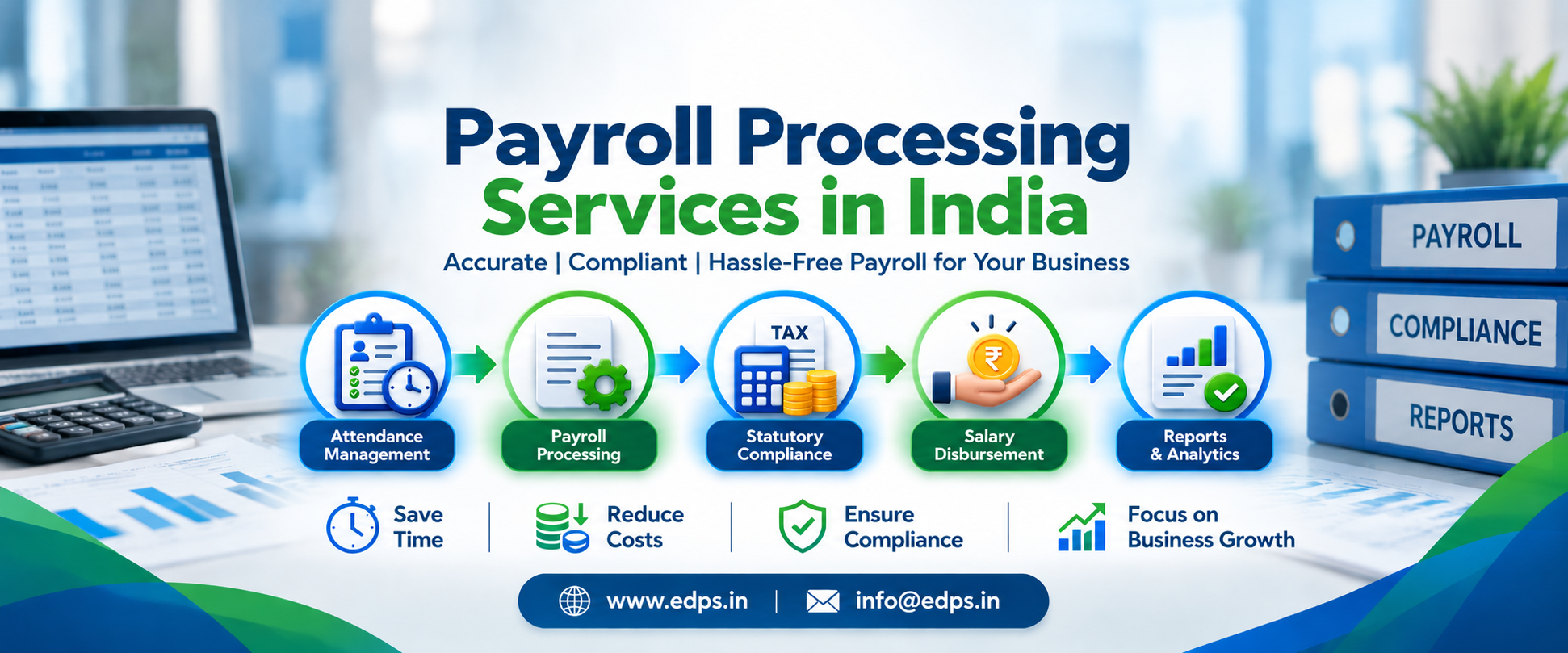
Corporate payroll services include salary calculations, statutory deductions, payslip generation, tax filing, and compliance reporting.
-
Yes. Our payroll solutions are designed to manage compliance and statutory filings for large employee bases.
-
Absolutely. We maintain high data security standards and encrypted storage to protect sensitive payroll information.
-
It’s a software platform for tracking and managing employee work hours, attendance, schedules, leave, and integration with payroll systems.
-
Yes — real-time attendance data automatically syncs with payroll modules, improving accuracy and compliance with Indian labour laws.
-
Absolutely — the system supports mobile, web, and device-based attendance tracking.
-
Small businesses should choose HRMS software that includes essential features such as employee database management, payroll processing, attendance and leave management, statutory compliance (PF, ESI, PT, TDS), recruitment tracking, and basic performance management. Cloud-based access, ease of use, and local compliance support are especially important for Indian businesses.
-
The pricing of HRM software in India usually depends on the number of employees and selected modules. For small businesses, costs typically start from affordable monthly per-employee plans and can scale as the organization grows. Many providers offer flexible pricing models, making HRM software cost-effective compared to manual HR management.
-
Yes. A good HRM software automates payroll calculations and ensures compliance with Indian labor laws. It manages PF, ESI, professional tax, income tax deductions, and statutory reports, reducing errors, penalties, and manual workload for small business owners.
-
HRM software helps small businesses save time, reduce administrative costs, improve accuracy, and enhance employee experience. It centralizes HR data, streamlines payroll and attendance, improves compliance management, and allows business owners to focus more on growth rather than daily HR tasks.
-
Absolutely. Most modern HRM software solutions in India are scalable and modular. Small businesses can start with core HR and payroll features and later add advanced modules such as performance management, recruitment, training, and analytics as their workforce and operational needs expand.
-
Employee self service is a digital HR system that allows employees to manage basic HR tasks such as leave, attendance, and salary slips on their own using an online portal or mobile app.
-
The employee self service meaning refers to giving employees direct access to their HR information while reducing dependency on HR teams for routine requests.
-
ESS in HRMS works as the employee-facing part of the system, where employees can apply for leave, view attendance, download payslips, and update personal details, while HR manages approvals and records.
-
The benefits of employee self service include reduced HR workload, faster approvals, improved payroll accuracy, better transparency, and an improved employee experience.
-
Yes, employee self service is useful for Indian SMEs and startups because it helps automate HR processes, manage payroll and leave efficiently, and scale operations without increasing HR staff.
-
Common employee self service examples include online leave applications, attendance tracking, salary slip downloads, tax declaration submission, and updating personal or bank details.
-
They typically handle salary calculations, statutory compliance, payslip generation, tax filings, employee self-service portals, and detailed payroll reporting.
-
Yes, payroll outsourcing is cost-effective and scalable, making it suitable for startups and small businesses as well as large enterprises.
-
Outsourcing payroll to specialists significantly reduces compliance risks by ensuring accurate filings and adherence to updated labor laws.
-
Payroll outsourcing is the process of hiring a third-party company to manage employee salaries, tax deductions, statutory compliance, payslips, and payroll reporting.
-
Indian companies outsource payroll to reduce compliance risk, save time and costs, ensure accuracy, and stay updated with changing labor and tax laws.
-
Yes, payroll outsourcing is completely legal in India as long as statutory requirements like PF, ESI, TDS, and labor laws are followed correctly.
-
They typically handle salary processing, payslips, tax calculations, PF & ESI compliance, bonus management, reimbursements, and payroll reports.
-
Costs vary based on employee count and services, usually ranging from ₹100 to ₹500 per employee per month.
-
Startups, SMEs, growing companies, and enterprises with complex compliance needs benefit the most from payroll outsourcing.
-
Yes, startups often outsource payroll to focus on growth while ensuring statutory compliance from day one.
-
Look for compliance expertise, experience, technology platform, data security, client reviews, and transparent pricing.
-
Yes, most payroll outsourcing companies manage PF, ESI, TDS, professional tax, and labor law compliance.
-
TDS deduction means tax is withheld by the payer before making certain payments such as salary, rent, professional fees, or contractor charges, and then deposited with the government.
-
Yes. Employers must deduct TDS from salary when the employee’s estimated annual taxable income creates a tax liability after considering eligible exemptions and deductions.
-
In most cases, TDS must be deducted at the time of credit or payment, whichever is earlier. Salary TDS is generally deducted during payroll processing each month.
-
Late deduction can attract interest and may create reconciliation issues, delayed certificate issuance, and compliance exposure during tax assessments or audits.
-
Delayed deposit can lead to interest, penalties, and return filing complications. It can also affect the recipient’s tax credit visibility.
-
An employee can verify tax credit through Form 26AS and the annual Form 16 issued by the employer, subject to proper reporting and reconciliation.
-
PAN is extremely important. In many situations, non-availability of PAN can lead to tax deduction at a higher rate as per the law.
-
No. Applicability depends on the nature of payment, threshold limits, legal section involved, and the status of the deductor and deductee.
-
Form 16 is generally issued for salary TDS, while Form 16A is generally issued for non-salary TDS where the relevant reporting and deduction conditions apply.
-
HR managers influence salary structures, declarations, payroll inputs, reimbursements, and final settlements. Errors in these areas can directly affect TDS accuracy and employee tax experience.
-
NEEM is a practical training initiative designed to improve employability by giving individuals real workplace exposure and industry-based learning opportunities.
-
NEEM is beneficial for young individuals who want to develop job-ready skills, gain practical experience, and improve their understanding of professional work environments.
-
NEEM helps organizations build a skilled talent pipeline by supporting structured training, improving workforce readiness, and aligning manpower development with business needs.
-
Yes, NEEM focuses on practical learning by allowing trainees to gain hands-on experience in real work settings, which helps them understand workplace expectations and responsibilities.
-
EDP Services helps businesses strengthen workforce support through structured, professional, and reliable solutions that improve training coordination, operational efficiency, and talent readiness.
-
Punch in your income, deductions and tax details on the “Annual Assessment Form” available after you register or log in to the Income Tax e-filing portal.
-
The Income Tax Return (ITR) filing deadline for FY 2022–23 (AY 2023–24) is July 31, 2023. Interest is chargeable under section 234A and a penalty under section 234F for late filing.
-
If the total income is above ₹5 lakh, penalty: ₹5,000; otherwise: ₹1,000. This penalty rises to ₹10,000 after 31st December 2023.
-
In fact, under Section 276CC of the Income Tax Act, non-filing can result in up to 6 months to 7 years' imprisonment.
-
We help you claim refunds, manage future losses and contribute towards your legal obligations through ITR filing.
-
The biggest benefit is lower tax rates and simplified compliance.
-
No. Input Tax Credit is not allowed.
-
No. You cannot sell goods across states under this scheme.
-
Businesses that:
- Need ITC
- Operate interstate
- Plan rapid expansion
-
Yes. You can switch if your turnover exceeds the limit or business needs change.
-
The ECR for May 2026 wage month must be filed and paid by June 15, 2026. This follows the standard rule of the 15th of the following month.
-
You'll face 12% per annum interest on delayed dues under Section 7Q, plus damages under Section 14B ranging from 5% to 25% per annum depending on delay duration.
-
EPFO granted extensions for September 2025 (to October 22, 2025) and December 2025 (to January 22, 2026), but no blanket extension exists for 2026. Future months follow the regular 15th deadline.
-
Yes — the revamped ECR 2.0 system (launched September 2025) includes a revision window for correcting inadvertent errors under certain conditions, a first-time feature for employers.
-
No. Once you upload the ECR and generate a challan, Forms 5, 10, 12A, 3A, and 6A are automatically covered. No separate filing is required.
-
Payroll is the process of calculating and paying employee salaries while managing deductions such as taxes, provident fund (PF), employee state insurance (ESI), professional tax, and other statutory contributions. It also includes maintaining payroll records and ensuring compliance with labor and tax laws.
-
In a company, payroll refers to the system used to manage employee compensation. It covers salary calculations, overtime, bonuses, reimbursements, tax deductions, payslip generation, and timely salary disbursement.
-
Payroll typically includes the following:
- Basic salary
- Allowances
- Overtime pay
- Bonuses and incentives
- Tax deductions (TDS)
- PF and ESI contributions
- Professional Tax (where applicable)
- Leave deductions
- Net salary payment
- Payslip generation
-
The primary purpose of payroll is to ensure employees receive accurate and timely salaries while helping businesses comply with tax regulations and labor laws. A well-managed payroll system also improves employee satisfaction and reduces compliance risks.
-
Payroll works by collecting employee attendance and salary data, calculating earnings and deductions, processing taxes and statutory contributions, generating payslips, transferring salaries, and filing required government returns.
-
The main types of payroll are the following:
- Manual Payroll
- In-house Payroll Software
- Outsourced Payroll Services
- Cloud-Based Payroll Systems
Each option offers different levels of automation, control, and compliance support.
-
Payroll processing is the complete workflow of calculating employee wages, applying deductions, verifying payroll data, paying employees, generating reports, and maintaining compliance with applicable tax and labor regulations.
-
Payroll is usually processed monthly, but some organizations process payroll weekly, bi-weekly, or semi-monthly depending on company policy and local regulations.
-
Common payroll documents include:
- Employee ID and personal details
- PAN and Aadhaar
- Bank account details
- Salary structure
- Attendance records
- Leave records
- Investment declarations
- PF and ESI information (if applicable)
-
Salary is the fixed amount an employee earns for their work, while payroll is the complete process of calculating, managing, and distributing that salary after accounting for deductions, taxes, benefits, and compliance requirements.
-
Payroll outsourcing is the practice of hiring a third-party payroll service provider to manage payroll calculations, tax compliance, salary processing, statutory filings, and payroll reporting on behalf of a business.
-
Payroll is important because it ensures employees are paid correctly and on time. It also helps businesses comply with legal requirements, avoid penalties, maintain accurate financial records, and build employee trust.
-
Outsourcing payroll helps businesses save time, improve payroll accuracy, reduce administrative workload, strengthen statutory compliance, enhance data security, and allow HR teams to focus on strategic business priorities.
-
Yes. Small businesses often benefit from payroll outsourcing because it eliminates the need for dedicated payroll resources while providing access to professional payroll expertise and modern payroll technology.
-
Reputable payroll providers use secure systems, access controls, encryption, and established data protection practices to safeguard sensitive employee information.
-
Yes. Professional payroll providers assist businesses in managing statutory payroll requirements, preparing payroll records, and supporting timely compliance activities in accordance with applicable regulations.
-
The cost depends on several factors, including the number of employees, payroll complexity, service scope, compliance requirements, and technology features. Businesses should request a customized quotation based on their specific needs.
-
Yes. Payroll outsourcing providers can manage payroll for organizations operating across multiple offices or states while addressing location-specific payroll requirements and compliance obligations.
-
Blue-collar bulk hiring is the process of recruiting a large number of operational or manual workers within a short period to meet business requirements.
-
Manufacturing, logistics, retail, construction, hospitality, healthcare, FMCG, and automotive industries frequently require bulk hiring.
-
Using faster onboarding, WhatsApp communication, local hiring, and recruitment partners can significantly reduce no-show rates.
-
Recruitment agencies provide access to a larger talent pool, faster hiring, compliance support, and lower recruitment costs.
-
Outsourced HR services allow a small business to use an external HR provider for functions such as payroll, recruitment, onboarding, attendance, employee records, HR administration, and compliance support.
-
Commonly outsourced functions include payroll processing, recruitment, onboarding, attendance and leave management, HR documentation, statutory compliance support, and employee lifecycle administration.
-
Yes. Startups can use HR outsourcing to establish structured HR processes without immediately building a large internal HR department. The approreports,model depends on workforce size, hiring plans and operational requirements.
-
A payroll provider can manage salary calculations, attendance inputs, deductions, payslips, payroll reports, and related processes. Clear data ownership, approval procedures, and responsibilities should be agreed upon in advance.
-
Evaluate the provider's HR expertise, service scope, payroll controls, compliance knowledge, technology, data security, communication process, scalability, pricing and contractual responsibilities.
-
EDP Services offers HR outsourcing, payroll outsourcing, recruitment and talent acquisition, manpower outsourcing, HR statutory compliance, time and attendance management, and HRMS-related solutions.
-
It is a special one-time opportunity allowing employers to voluntarily enrol eligible employees who were left outside EPF coverage during the specified period, subject to campaign conditions.
-
The campaign is open until 31 October 2026. Employers should complete the required process before the deadline.
-
The campaign covers eligible employees left outside EPF coverage between 1 April 2009 and 31 March 2026, subject to the prescribed conditions.
-
The campaign requires the declared employee to be alive and continuing in employment with the establishment on the date of declaration. Therefore, employers should verify eligibility rather than assuming former employees qualify.
-
Where the employee's share was not deducted from wages earlier, it is waived under the specified campaign conditions. Employers remain responsible for the applicable employer contribution, interest, and administrative charges.
-
Yes, establishments that are covered or coverable under the applicable EPF framework should review their records and determine whether they have eligible employees who were left outside coverage.
-
The campaign provides an online process through the EPFO Employer Portal, including prescribed declaration, Face Authentication-based UAN generation through UMANG and ECR-linked contribution filing.
-
Employers should review historical employee and payroll records, identify potential gaps, verify eligibility, and complete the prescribed enrolment and contribution process well before 31 October 2026.
-
Payroll services help businesses manage employee salary calculations, deductions, payslips, payroll records, and applicable statutory requirements. The exact services depend on the provider and selected package.
-
Payroll service costs vary depending on the number of employees, payroll complexity, attendance integration, compliance requirements, and the provider's pricing model. Request a quotation based on your business requirements.
-
Yes. Payroll outsourcing can be useful for small businesses that want professional payroll support without managing every payroll activity internally. Businesses should compare cost, service scope, data security, and support before choosing a provider.
-
Payroll software helps businesses calculate salaries, maintain records, and manage payroll workflows. Payroll outsourcing involves assigning agreed payroll activities to an external service provider. Some businesses use software and professional services together.
-
Depending on the service package, payroll providers can help with applicable deductions, calculations, records, and filing processes. Requirements depend on current regulations and the employer's circumstances.
-
Compare service coverage, pricing, payroll accuracy controls, reporting, data protection, customer support, software compatibility, and relevant compliance expertise before selecting a provider.
-
Staffing solutions are services that help businesses recruit and deploy employees according to their workforce requirements. They may include permanent recruitment, temporary staffing, contract staffing, executive search, and project-based hiring.
-
The main types include permanent staffing, temporary staffing, contract staffing, executive search, and project-based staffing. The right option depends on the job role, hiring duration, and business requirements.
-
Staffing agencies typically understand the employer's requirements, source candidates, screen applications, coordinate interviews, and support selection. Additional services may include onboarding and workforce administration.
-
Staffing solutions can help businesses streamline recruitment, access a wider candidate pool, manage changing workforce requirements, and reduce the administrative workload associated with hiring.
-
Staffing solutions generally focus on sourcing and hiring suitable employees for specific roles. Manpower outsourcing can cover a broader range of workforce activities, potentially including recruitment, deployment, documentation, attendance coordination, and payroll support, depending on the agreement.
-
Manufacturing, IT, healthcare, retail, logistics, construction, hospitality, banking, and other industries can use staffing solutions according to their recruitment and operational requirements.
-
Businesses should evaluate recruitment expertise, candidate screening processes, industry experience, service scope, communication, pricing, and applicable compliance responsibilities before selecting a staffing partner.
-
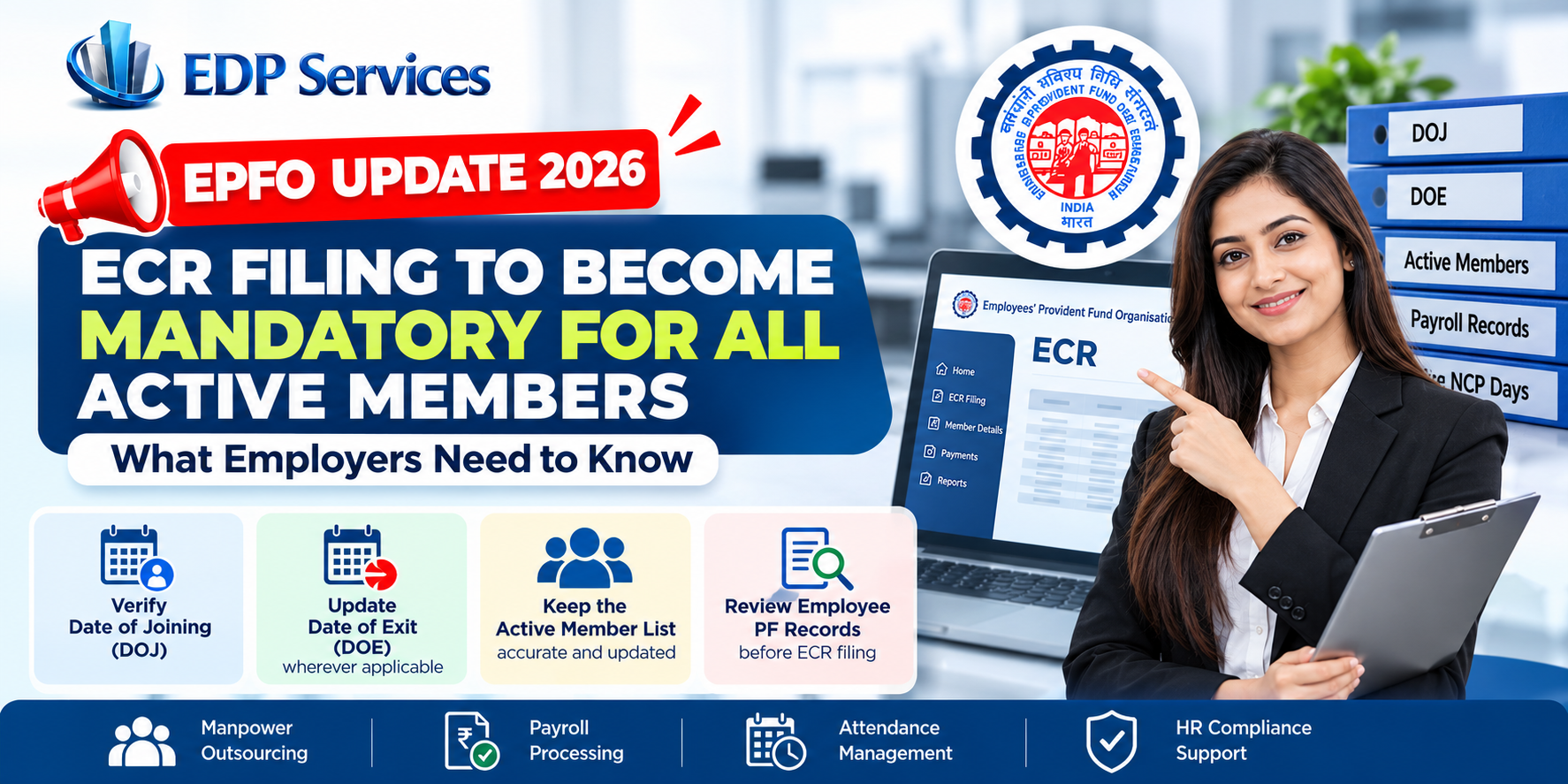
The EPFO employer portal notice states that ECR filing for all active members will become mandatory shortly. It asks employers to update joining and leaving details to keep the active member list accurate.
-
The wording shown in the notice says the requirement will be made mandatory “shortly.” The notice alone does not establish that the change has already taken effect or specify an implementation date. Employers should check official EPFO instructions for further details.
-
DOJ means Date of Joining. It is an important employment record that should be accurate and consistent with the relevant joining documentation and EPFO records.
-
DOE means Date of Exit. It records the relevant exit date when an employee leaves employment. Employers should update applicable exit information according to EPFO requirements.
-
NCP Days are Non-Contributory Period days. In ECR reporting, they generally represent days in the wage month for which wages are not due. The correct value depends on the employee's circumstances and applicable reporting instructions.
-
Not automatically. The employee was not employed by that employer before the actual joining date, so those days should not automatically be treated as unpaid absence during employment. The employer should record the correct DOJ and follow the applicable ECR instructions.
-
Verify the employee's exit details against the relevant records and follow the applicable EPFO process to update the information. The appropriate correction route may depend on the nature of the case.
-
Incorrect employment details may create discrepancies during service-history verification, PF transfers, withdrawals, or related processes. Accurate records help reduce avoidable complications.
-
Depending on the case, HR teams should review joining records, exit documentation, employee master data, attendance and leave records, wage registers, payroll reports, and contribution calculations.
-
Employers should refer to the official EPFO website and the relevant employer portal notices, circulars, FAQs, and instructions.