

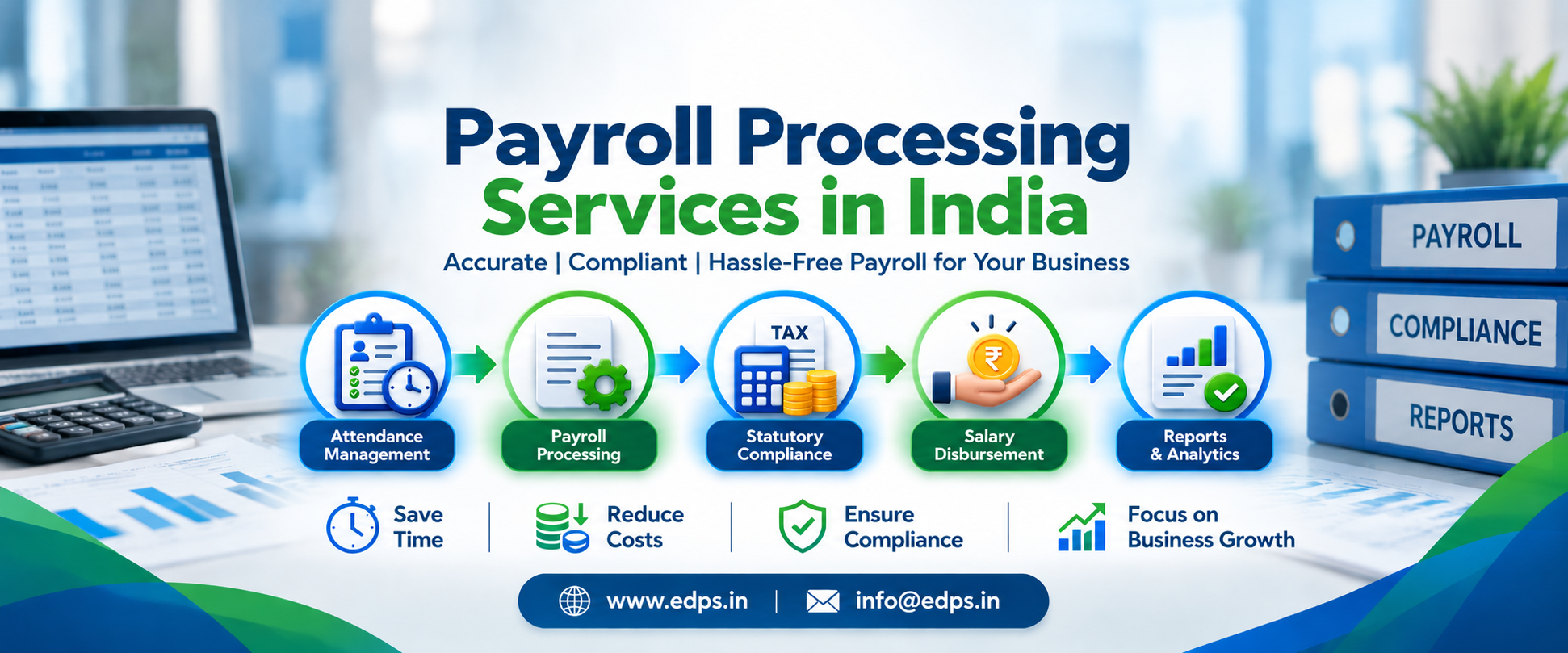
Payroll is one of the most important responsibilities for every employer. Employees expect their salaries to be accurate and paid on time, while businesses need to manage attendance, leave, deductions, salary structures, records, and applicable compliance requirements correctly.
As a company grows, payroll can quickly become more complicated. Managing employee information through spreadsheets, collecting attendance data manually, calculating deductions, and preparing monthly payroll reports can consume significant HR and finance resources.
This is why many organizations are turning to payroll processing services in India.
Professional payroll support can help businesses streamline salary processing, reduce repetitive administrative work, improve payroll accuracy, and create a more structured payroll workflow.
In this guide, we will explain how payroll processing works, what services are commonly included, the benefits of outsourcing payroll, common challenges, and how employers can choose the right payroll partner.
What Are Payroll Processing Services?
Payroll processing services involve managing the activities required to calculate, prepare, and administer employee salaries.
Depending on the provider and the organization's requirements, payroll services may include:
- Employee salary calculation
- Attendance and leave data processing
- Overtime calculations
- Salary deductions
- Payroll preparation
- Payslip generation
- Payroll reports
- Employee payroll records
- Full and final settlement support
- Payroll-related compliance processes
For businesses that do not want to manage every payroll activity internally, professional payroll services can provide structured support for day-to-day payroll administration.
The objective is not simply to calculate salaries. A good payroll process should make salary administration more accurate, organized, secure, and easier to manage.
How Does Payroll Processing Work in India?
A typical payroll cycle involves several interconnected steps.
Although the exact process differs from one organization to another, the following workflow is common.
1. Employee Data Collection
The first step is maintaining accurate employee information.
This may include:
- Employee name and identification details
- Designation and department
- Date of joining
- Salary structure
- Bank details
- Attendance information
- Leave records
- Applicable deductions
- Employee status
Accurate employee data is essential because even a small error can affect salary calculations.
2. Attendance and Leave Verification
Attendance and leave information can directly affect payroll.
HR teams may need to verify:
- Present days
- Absences
- Paid leave
- Unpaid leave
- Overtime
- Shift information
- Attendance corrections
For organizations with multiple locations or shifts, digital time and attendance management can make it easier to organize workforce attendance data before payroll is processed.
3. Salary Calculation
Once employee information and attendance inputs are verified, payroll calculations can be prepared according to the organization's salary structure.
Depending on the employee and company policy, payroll may involve:
- Basic salary
- Allowances
- Incentives
- Overtime
- Reimbursements
- Deductions
- Applicable statutory contributions
- Other salary components
4. Payroll Compliance and Deductions
Payroll is closely connected with employment-related tax and statutory requirements.
The applicable requirements can depend on factors such as employee salary, location, organization type, and current regulations.
Therefore, businesses should have a process for reviewing applicable requirements and ensuring that payroll calculations and deductions are handled appropriately.
5. Payslip Generation
After payroll calculations are reviewed and finalized, employees can receive their salary information through payslips.
A clear payslip helps employees understand:
- Gross earnings
- Applicable deductions
- Net salary
- Other relevant salary components
This transparency can also reduce unnecessary payroll-related queries.
6. Salary Disbursement and Reporting
After final approval, salary data can be used for employee payments according to the organization's payroll process.
Payroll reports can also help HR and finance teams review salary expenses, employee costs, deductions, and other relevant information.
Why Are Payroll Processing Services Important for Employers?
Payroll is more than a monthly administrative task.
It directly affects employee satisfaction, HR efficiency, financial planning, and compliance.
A poorly managed payroll process can result in:
- Incorrect salary payments
- Delayed salary processing
- Employee complaints
- Repeated manual corrections
- Additional administrative work
- Compliance risks
- Loss of employee confidence
A structured payroll process helps businesses create consistency and reduce unnecessary operational friction.
Key Benefits of Payroll Processing Services in India
1. Reduces HR Workload
Payroll requires regular data collection, verification, calculations, reporting, and employee support.
Outsourcing repetitive payroll activities can allow HR professionals to spend more time on recruitment, employee engagement, workforce planning, and other strategic responsibilities.
2. Helps Improve Payroll Accuracy
Manual payroll processing can involve multiple spreadsheets and repeated data entry.
A structured payroll system, supported by appropriate checks and automation, can reduce common calculation and data-entry errors.
However, automation does not remove the need for human review. Accurate input data and proper approval processes remain important.
3. Supports Payroll Compliance
Payroll can involve multiple regulatory and tax-related responsibilities.
A professional payroll provider can help businesses establish structured processes for applicable payroll-related requirements.
Employers should always ensure that the services included by the provider match their specific requirements.
4. Improves Employee Experience
Employees generally want three things from payroll:
Accuracy + Timeliness + Transparency
They expect their salary to arrive on time and want to understand their earnings and deductions.
A well-managed payroll process can improve employee confidence and reduce avoidable payroll queries.
5. Helps Businesses Scale
A small business may initially manage payroll using spreadsheets.
However, as employee numbers increase, manual processes can become increasingly difficult to control.
Outsourced payroll services can provide a more organized workflow as the workforce expands.
Payroll Processing vs In-House Payroll
|
Factor |
In-House Payroll |
Outsourced Payroll |
|
Payroll management |
Internal team |
External payroll specialists |
|
HR workload |
Generally higher |
Can be reduced |
|
Technology |
Managed by business |
Often supported by the provider |
|
Scalability |
Additional internal resources may be needed. |
Easier to scale depending on provider |
|
Payroll expertise |
Must be developed internally |
Provider expertise available |
|
Reporting |
Internal responsibility |
Provider-supported options |
|
Administrative effort |
Higher |
Potentially lower |
|
Cost structure |
Employee + technology costs |
Service-based cost |
Neither approach is automatically right for every company.
The decision should depend on workforce size, payroll complexity, internal expertise, technology requirements, budget, and the level of control the organization wants to maintain.
Common Payroll Challenges Faced by Indian Businesses
Manual Data Entry
When HR teams manually transfer information between attendance sheets, employee records, and payroll spreadsheets, errors can occur.
Multiple Salary Structures
Employees may have different salary components, incentives, allowances, deductions, or reimbursement arrangements.
This can make payroll administration more complex.
Attendance and Payroll Disconnect
If attendance information is maintained separately from payroll, HR teams may need to repeatedly transfer data.
Integrating payroll with time and attendance management can help create a smoother workflow.
Employee Changes
Payroll teams need to account for:
- New employees
- Resignations
- Promotions
- Salary revisions
- Transfers
- Leave changes
- Employee exits
If these changes are not updated correctly, payroll errors can occur.
Compliance Updates
Payroll-related rules and requirements can change over time.
Businesses therefore need a process for reviewing applicable updates and adjusting payroll workflows when necessary.
How Cloud Technology Is Changing Payroll Processing
Payroll is increasingly becoming part of a connected digital HR ecosystem.
Instead of managing every HR function separately, businesses can connect:
Employee Records → Attendance → Leave → Payroll → Payslip → Reporting
Modern cloud-based HR solutions can help organizations centralize workforce information and connect different HR processes.
For example, attendance information can feed into payroll, while employee information can be maintained within a centralized system.
Cloud-based systems can also provide authorized HR users with access to workforce information from different locations.
However, businesses should evaluate data security, user permissions, access controls, backups, and provider practices before implementing any cloud HR system.
Payroll Outsourcing for Small Businesses and SMEs
Payroll outsourcing can be particularly useful for startups and SMEs that do not have a large internal HR or payroll team.
A growing business may need to manage payroll while simultaneously handling:
- Recruitment
- Employee onboarding
- Attendance
- HR documentation
- Compliance
- Employee queries
- Workforce planning
Managing all these functions internally can put pressure on a small HR team.
In such situations, HR outsourcing solutions can help businesses delegate selected HR and administrative responsibilities while allowing internal teams to focus on core business priorities.
The exact scope of outsourcing should be clearly defined before starting the engagement.
How to Choose the Right Payroll Processing Company
Choosing a payroll partner should not be based only on price.
Before selecting a provider, employers should evaluate the following factors.
1. Payroll Expertise
Does the provider understand your industry, employee structure, and payroll requirements?
2. Compliance Support
Does the provider support the payroll-related compliance processes relevant to your organization?
3. Data Security
Payroll contains confidential employee information.
Ask how employee data is stored, accessed, protected, and backed up.
4. Technology
Check whether the provider uses reliable payroll technology and whether the system supports your workforce requirements.
5. Attendance Integration
If your organization uses digital attendance or shift management, determine whether the payroll process can incorporate relevant attendance information.
6. Reporting
Ask what payroll reports are available and whether they can support HR and finance requirements.
7. Employee Support
There should be a clear process for handling employee questions related to salary, payslips, deductions, and payroll records.
8. Scalability
Choose a solution that can support your business as employee numbers and locations increase.
9. Accuracy and Review Controls
Ask what validation and approval procedures are followed before payroll is finalized.
10. Customer Support
Payroll is time-sensitive. Make sure there is a defined process for resolving urgent payroll issues.
Payroll Best Practices for Employers
Whether payroll is handled internally or outsourced, businesses should follow a consistent process.
Payroll checklist
- Keep employee records updated.
- Verify attendance before payroll processing.
- Review leave records.
- Check new joiners and exits.
- Verify salary revisions.
- Review deductions and applicable contributions.
- Validate payroll calculations.
- Generate and review payroll reports.
- Protect employee payroll information.
- Restrict payroll access to authorized users.
- Maintain records securely.
- Establish a clear employee query process.
These practices can help create a more reliable payroll operation.
What Employees Expect From a Good Payroll System
Payroll is also an employee-experience issue.
Employees generally expect:
- Accurate salary calculations
- Timely salary payments
- Clear payslips
- Transparent deductions
- Easy access to payroll information
- Quick resolution of payroll queries
When these expectations are consistently met, payroll becomes less of a source of confusion for employees.
For employers, this means payroll accuracy should be viewed not only as a finance responsibility but also as an important part of employee trust.
The Future of Payroll Processing in India
Payroll management is moving toward greater automation, integration, and digital accessibility.
Businesses are increasingly connecting payroll with attendance, employee databases, leave management, recruitment, and other HR functions.
The future of payroll is therefore not simply about calculating salaries faster.
It is about building a connected workforce management system where accurate employee data can move efficiently between HR processes.
At the same time, human oversight will remain important. Payroll technology can automate calculations and workflows, but organizations still need people to validate data, review exceptions, handle employee concerns, and make responsible decisions.
Frequently Asked Questions
1. What are payroll processing services in India?
Payroll processing services help businesses manage employee salary calculations, attendance inputs, deductions, payslips, payroll records, reporting, and other payroll-related activities.
2. Is payroll outsourcing suitable for small businesses?
Yes. Small businesses and startups can use payroll outsourcing to reduce administrative work and access professional payroll support without maintaining a large internal payroll team.
3. What is included in payroll processing services?
Depending on the provider, services may include salary processing, attendance and leave inputs, deductions, payslip generation, payroll reports, employee records, and payroll-related compliance support.
4. How does payroll outsourcing save time?
Payroll outsourcing allows businesses to delegate repetitive payroll administration activities to a specialist provider, reducing the operational workload on internal HR and finance teams.
5. Is payroll software better than manual payroll?
Payroll software can improve efficiency by automating calculations, records, workflows, and reporting. However, software still requires accurate data, correct configuration, and appropriate human review.
6. How can businesses reduce payroll errors?
Businesses can reduce payroll errors by maintaining accurate employee information, verifying attendance and leave, reviewing salary changes, using standardized workflows, and performing payroll checks before final approval.
7. Can attendance and payroll be connected?
Yes. Depending on the technology used, attendance and payroll systems can be integrated or connected so relevant attendance information can be incorporated into payroll processing.
8. What should I check before choosing a payroll processing company?
Employers should evaluate payroll expertise, technology, data security, compliance support, reporting, scalability, customer service, accuracy controls, and experience with similar businesses.
Conclusion
Payroll processing services in India can help businesses create a more efficient, structured, and reliable approach to salary administration.
From employee data and attendance to salary calculations, deductions, payslips, reporting, and applicable payroll-related compliance processes, a well-designed payroll workflow can reduce administrative pressure on HR and finance teams.
For startups and SMEs, payroll outsourcing can provide access to professional support as the workforce grows. For larger organizations, it can help manage high-volume and multi-location payroll operations more efficiently.
However, choosing the right payroll solution requires more than comparing prices. Employers should consider accuracy, security, compliance, technology, scalability, reporting, and employee experience.
The ultimate goal is simple: pay employees accurately and on time while giving HR teams more time to focus on people and business growth.