

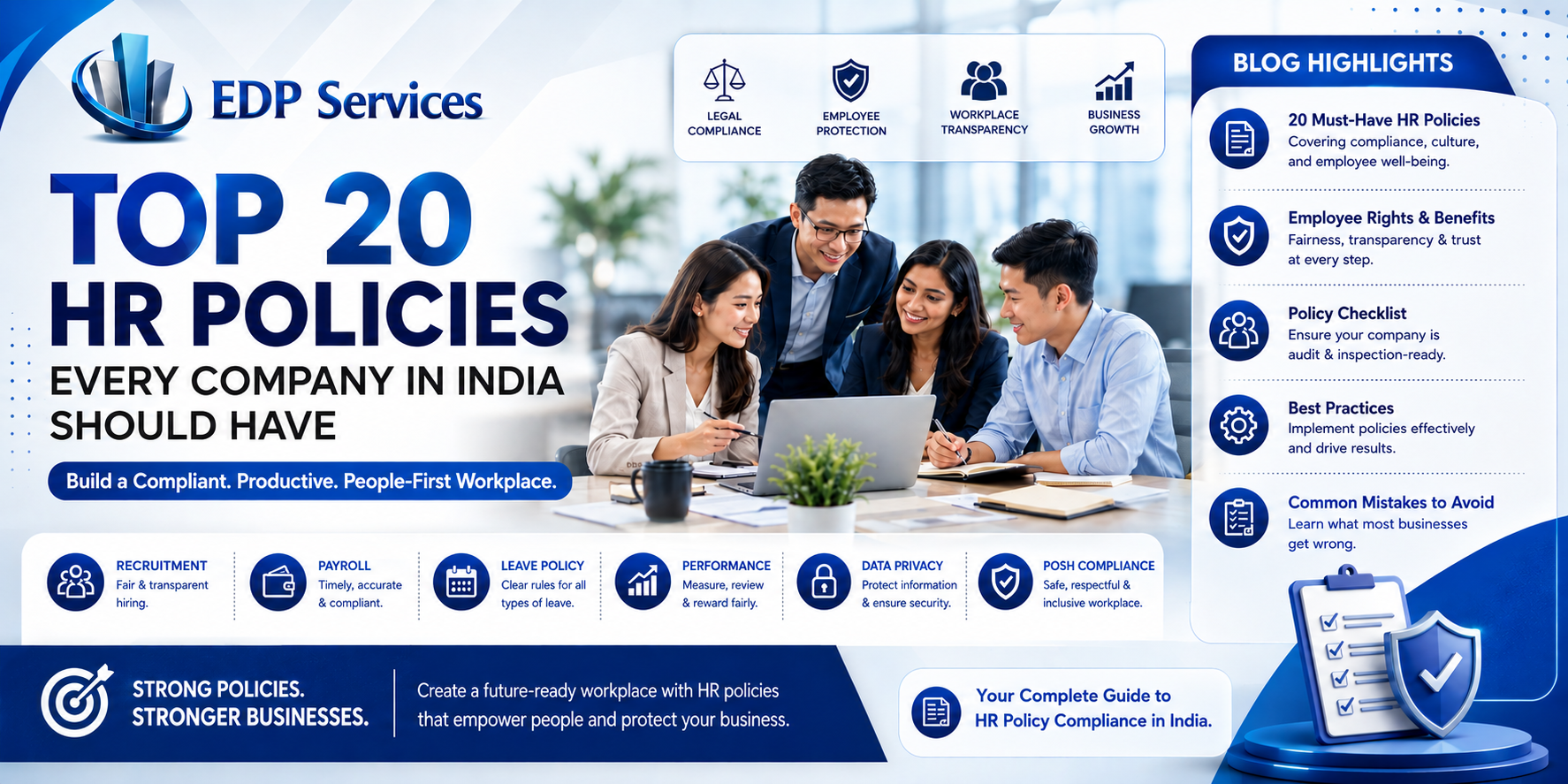
Every successful business is built on a clear set of rules, fair practices, and strong relationships with its employees. Having well-defined HR policies in India is essential for startups, SMEs, and large enterprises alike to maintain compliance, improve workplace culture, and protect both employers and employees.
HR policies have a framework of managing employees in a consistent and professional manner. They also help organizations comply with labour laws, reduce legal risks, and increase productivity.
In this guide, we will discuss the 20 best HR policies in India that every company should have to create a compliant and employee-friendly workplace.
What is the importance of HR policies?
An effective HR policy for companies serves as a roadmap for employee management. It explains workplace expectations, employee rights, company procedures, and legal responsibilities.
How do employee rights policies benefit the organization?
HR policies help employers and employees in the following ways: -
- They make sure you keep on the right side of the law
- They create workplace transparency
- They decrease employee discontent
- They enhance productivity
- They cultivate trust between employer and employee
- They make it easier to consistently make up decisions
- They help your company culture.
A good HR policy checklist can also help the company remain audit and inspection-ready at all times.
Top 20 HR Policies for Indian Companies Every Company in India Should Have
1. Recruitment and Hiring Policy
This procedure outlines the way in which candidates are sourced, interviewed, and selected for the role in a fair manner. This regulation promotes non-discriminatory employment practices and the transparency of the recruitment process.
2. Employee Onboarding Policy
A formal onboarding policy enables new hires to better understand company values, workplace culture, policies, and job obligations starting on their first day.
3. Code of Conduct Policy
The Code of Conduct clarifies the degrees of fairness, ethics, professionalism, confidentiality, and punishment expected in the work environment.
4. Attendance and Working Hours Policy
This policy describes work hours, attendance, overtime,Working Hours Policy in addition to your duty hours, attendance, overtime, late, flexible working time, shift administration.
5. Leave Policy
An ideal leave policy must have the following explanations:
- Casual Leave
- Sick Leave
- Earned Leave
- Maternity Leave
- Paternity Leave
- Public Holidays
- Procedure to apply for leave
It's also one of the most critical HR policies for employees.
6. Payroll and Salary Policy
The salary policy informs about the company’s pay scale, dates of payments, deductions and bonuses, reimbursements, and payments towards the statutory contributions, namely PF and ESI if applicable.
7. Performance Management Policy
This is what employees really need to know about how we measure performance, how we get feedback, and how we get promoted and compensated.
8. Remote Work and Work From Home Policy
Flexible working conditions are increasingly common these days.
A remote work policy should include:
- Working hours
- Expectations for communication
- Security of the data
- Standards for productivity
- Responsibility for the equipment
9. Data Privacy and Confidentiality Policy
Winning at business is not possible with compromised or stolen data. This policy includes information about confidential information, cybersecurity, passwords, and company systems’ acceptable use policy.
10. Anti-Harassment and POSH Policy
All employers should ensure compliance with the Prevention of Sexual Harassment (POSH) mandate. This policy should inform about procedures for complaints, employee rights, and safe workplaces.
11. Equal Opportunity Statement
The Equal Opportunity Policy helps to bring a positive impact on the underrepresented minority groups in society by way of providing equal opportunity without any bias towards sex, religion, disability, age, colour or caste.
12. Employee Grievance Policy
There should be a clearly defined mechanism through which employees can raise concerns, grievances, or complaints relating to their workplace or work experiences without the risk of reprisal.
13. Disciplinary Action Policy
This policy describes misbehavior, investigation process, warning system, suspension, and disciplinary actions against an employee.
14. Health & Safety Policy
By specifying workplace safety policies, emergency responses, and worker duties, organizations can advise employees of what is expected of them and promote a safer work environment.
15. Training Policy and Development
Learning is a continuous process for employees to enhance their skills and contribute to the growth of business. This policy describes the requirements for professional development and training that is compulsory.
16. IT - Acceptable Use Policy
Employees need to be made aware of what constitutes responsible use of the company’s laptops, e-mail accounts, Internet access, and software.
17. Reimbursement of Expenses Policy
This policy outlines the definition of allowable business expenditure, procedures for reimbursement, types of supporting documents to be submitted, and deadlines for approval.
18. Exit and Separation Policy
An exit policy should include the following:
- Notice period
- Resignation process
- Exit interviews
- Final payment and Clearance
- Return of company assets
Culture shock-free separation—All in all here we discussed how to make employee exit smoother and less shocking for your company and staff.
19. Whistleblower Policy
An emphasis should be placed on trying to cultivate an environment where employees are encouraged to report unethical conduct, fraud, and policy breaches confidentially. This policy enhances organizational integrity.
20. Statutory/Compliance Policy
This is a guide to ensure that you are compliant with Indian labour law by ensuring that you are conforming to labour law procedures, etc. Ongoing audits enable organizations to adapt to evolving regulations.
HR Policy Checklist for Every Company
Evaluate your company with this simple-to-use HR policy checklist:
Use the following checklist:
- Recruitment Policy
- Onboarding Policy
- Workplace Attendance Rules and Regulations, Leave of Absence, and Work Schedule.
- Policy on Leave
- Payroll Policy
- Code of Conduct
- POSH Policy
- Performance Management Policy
- Data Privacy Policy
- Health & Safety Policy (H&S)
- Policy on Grievance
- Exit Policy
- Whistleblower Policy
- Policy compliance
Get your HR policies in check. If you're missing any of these policies, it's time to update your HR paperwork.
Best Practices for Implementing HR Policies
Policy development is only the first step. To make sure that they serve their purpose:
- Write policies in plain language and keep them simple.
- Stay on top of changes in employment law.
- Distribute them to all employees as part of their onboarding package.
- Update policies on an annual basis.
- Policies implementation training for managers
- Store digital records for easy retrieval.
- Inform on a timely basis of changes in policies.
With these best practices, companies are able to establish an open and compliant workplace.
Common Mistakes Companies Should Avoid
Many businesses develop policies that are never put into effect.
Avoid these common mistakes:
- Copied generic policies without any customization.
- Based on out-of-date legal information.
- Don't tell your policies to the employees who work for you, or they might get ideas.
- Never consider your policies acknowledged just because people sign.
- Don’t let your policies fall into disuse.
- Enforce policy inconsistently
Well-written corporate policies instill employee confidence and reduce exposure to litigation.
Conclusion
Effective HR policies in India are not merely internal documents—they form the basis of a compliant, efficient, and employee-friendly work environment. Essential HR Policies for Businesses: Whether you're running a small startup or an established company, the following critical HR policies will help you manage risk, boost employee satisfaction, and support business growth.
If you require professional guidance on HR policy writing, HR documentation, Labour law compliance in India, or payroll processing or complete HR outsourcing services, then get in touch with us at EDP Services. The seasoned HR experts at HR Answer line help companies create business-tailored, legally defensible HR policies that reflect the way you want to do business so you can scale your business with confidence.