
EPFO ECR Filing to Become Mandatory for All Active Members: What Employers Need to Know
Managing Employees' Provident Fund (EPF) compliance involves more than calculating monthly contributions and submitting returns. Employers must also maintain accurate employee records, including Date of Joining (DOJ), Date of Exit (DOE), wages, and contribution details.
The Employees' Provident Fund Organisation (EPFO) has displayed an important notice on its employer portal:
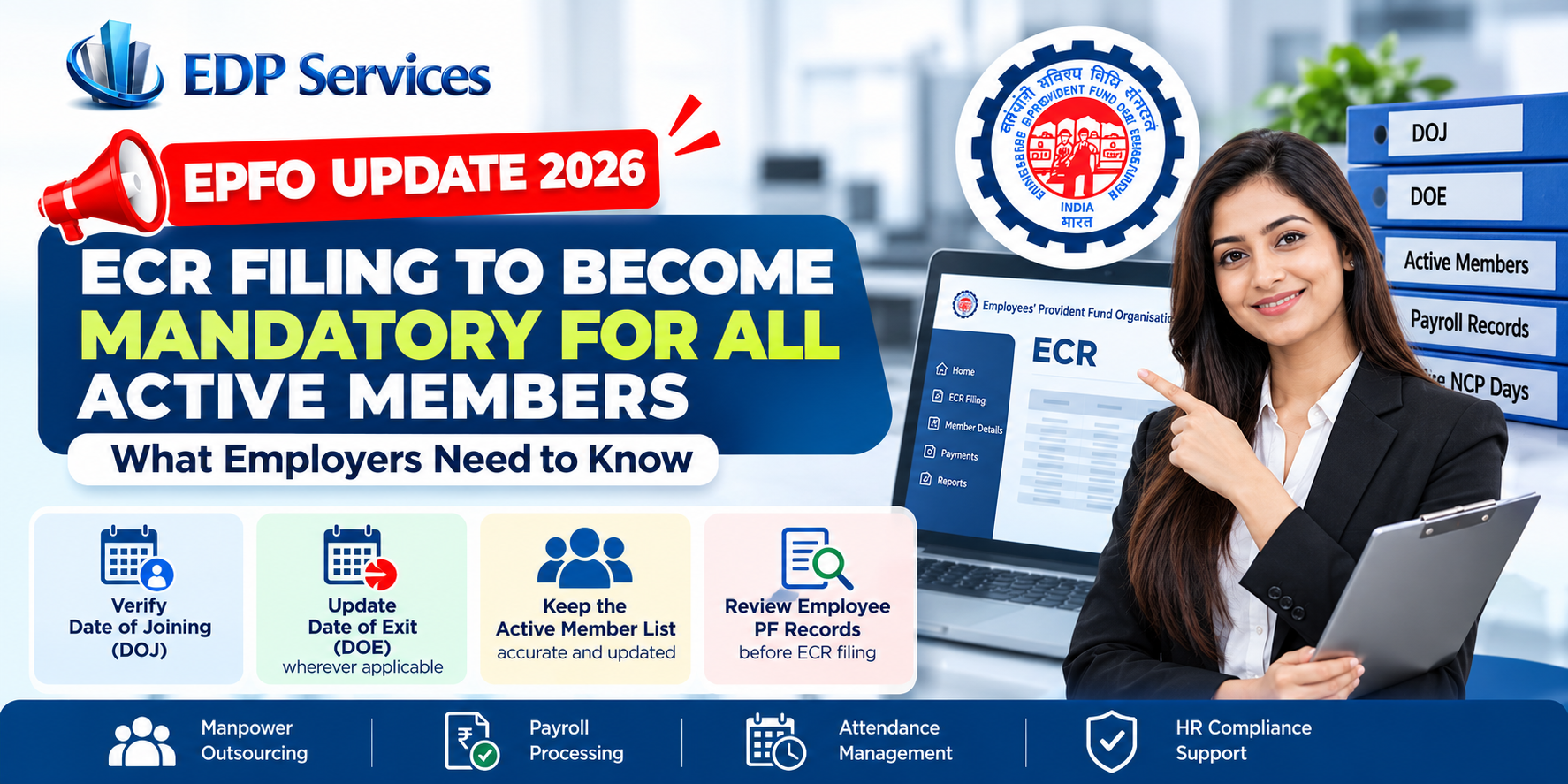
“The ECR for all Active Members shall be made mandatory shortly. You are requested to update the Joining and Leaving for the required members so as to keep the Active Member list updated and correct.”
This announcement is particularly relevant for HR departments, payroll teams, accountants, and business owners responsible for monthly EPF compliance.
The notice indicates that EPFO intends to make Electronic Challan-cum-Return (ECR) filing mandatory for all active members shortly. It also highlights the importance of maintaining correct joining and leaving information.
For employers, the practical priority is clear: review employee records, identify missing or incorrect dates, and ensure that payroll data matches the actual employment status of each worker.
In this guide, we explain the announcement, the role of DOJ and DOE, the meaning of NCP Days, and the steps employers should take to prepare for the upcoming requirement.
For more information, explore our Latest EPFO, ESI & Labour Law Updates
What Is the Latest EPFO ECR Update?
The latest development highlighted in the portal notice concerns ECR filing for all active members.
Until now, employers have prepared their monthly EPF returns based on applicable employee records and contribution requirements. Under the upcoming requirement described in the notice, ECR filing for all active members will become mandatory shortly.
The notice specifically asks employers to update joining and leaving information so that the active member list remains accurate.
Key points of the announcement
-
ECR filing: EPFO states that filing for all active members will become mandatory shortly.
-
Joining details: Employers are requested to update the Date of Joining wherever required.
-
Leaving details: Employers should ensure that applicable Date of Exit information is recorded correctly.
-
Active member list: Employee records must reflect the correct employment status.
-
Employer preparation: HR and payroll teams should review their records before the requirement becomes effective.
It is important to distinguish the portal announcement from a fully implemented rule. The wording “shall be made mandatory shortly” does not specify an effective date in the notice shown here.
Employers should therefore monitor official EPFO communications for implementation instructions and any additional filing requirements.
The revamped ECR system already introduced system-based validations and changes to the return-filing process from the September 2025 wage month. EPFO's October 2025 FAQ release provides further information about that system. Official EPFO ECR FAQ announcement.
What Is ECR in EPFO?
ECR stands for Electronic Challan-cum-Return. It is the electronic return employers use to report employee-level information and applicable EPF contributions for a wage month.
The information generally includes employee identification, wages, contribution amounts, and other applicable details.
ECR plays an important role in ensuring that the contributions reported by an employer correspond to the employees covered under the return.
How does the revamped ECR system work?
EPFO introduced its revamped, or re-engineered, ECR system from the September 2025 wage month.
Key features described in the official FAQ include:
-
Separation of return filing from challan generation and payment.
-
System-based checks to identify errors in employee and contribution data.
-
Automated calculation of applicable interest and damages within the relevant process.
-
Provisions for revised returns under specified conditions.
These changes make accurate employee records and payroll reconciliation particularly important.
For example, an incorrect UAN, inconsistent wage figures, or an inaccurate employment record may create problems during return preparation or validation.
Employers should not wait until an ECR submission fails to begin reviewing their employee master data.
Who Are Active Members in EPFO?
An active member is generally an employee whose EPF membership or employment record is treated as active in the employer's relevant EPFO records.
For practical payroll management, employers should distinguish between employees who are currently employed, employees who have recently joined, and employees who have left the organisation.
An outdated active member list can create confusion during monthly return preparation.
For example, consider a company that employs 100 workers. During the month, five employees leave and three new employees join.
If the employer does not update the relevant records, the member list may not accurately reflect the company's current workforce.
This is why the portal notice asks employers to update joining and leaving information.
Why is the active member list important?
An accurate list helps employers:
-
Reconcile employee records with payroll data.
-
Identify missing joining or exit information.
-
Prepare monthly ECR returns more accurately.
-
Reduce discrepancies between employment records and reported contributions.
-
Maintain better documentation for compliance reviews.
The exact treatment of active members and the filing scope should follow the applicable EPFO instructions and portal validations.
Why Are DOJ and DOE Validation Important?
DOJ and DOE are two important dates in employee lifecycle management.
DOJ means Date of Joining, while DOE means Date of Exit. Both dates help establish the period during which an employee was associated with an employer.
Incorrect dates can create inconsistencies in service records, payroll calculations, and EPF-related processes.
1. Date of Joining (DOJ)
The Date of Joining is the employee's joining date recorded for the relevant employment and EPF membership, as applicable.
HR teams should verify the joining date against appropriate employment documentation and the employee's actual joining records.
For example, if an employee joins a company on 29 October 2026, the employer should maintain the correct joining date in its employee records and ensure that the applicable EPFO information is consistent.
Incorrect joining dates may lead to discrepancies when reporting new employees or reconciling their contribution details.
What should employers check?
-
The actual joining date in employment records.
-
The date recorded in the HR or payroll system.
-
The relevant EPFO membership details.
-
Whether the employee's records are complete and consistent.
2. Date of Exit (DOE)
The Date of Exit records the relevant employment exit date for EPFO purposes when an employee leaves an organisation.
When an employee resigns, retires, or otherwise leaves employment, the employer should update the applicable exit information in accordance with EPFO requirements.
For example, if an employee leaves the organisation on 15 October, HR should ensure that the correct exit information is recorded and supported by the company's employment records.
Leaving an employee's record incorrectly active can create confusion in the employer's member list and may complicate subsequent PF-related processes.
What should employers check?
-
Whether employees who have left are correctly identified.
-
Whether the applicable DOE has been updated.
-
Whether the exit date matches the relevant records.
-
Whether the required reason for leaving has been entered, where applicable.
3. What happens when DOJ or DOE is incorrect?
Incorrect or missing employment dates can result in:
-
Inconsistencies in employee service history.
-
Errors or discrepancies during ECR preparation.
-
Additional verification during PF transfer or withdrawal processes.
-
Difficulties reconciling HR, payroll, and EPFO records.
-
Delays while incorrect information is investigated or corrected.
EPFO has also simplified certain member-profile update processes. In its 19 January 2025 announcement, the Ministry of Labour and Employment explained that members with Aadhaar-validated UANs can update specified profile details, including DOJ and DOE, without uploading documents in eligible cases. Certain cases may still require employer certification. Read the official government announcement.
The applicable correction route depends on the nature of the error and the member's circumstances.
What Are NCP Days in EPFO?
NCP stands for Non-Contributory Period.
In ECR reporting, NCP Days generally represent the days in a wage month for which wages are not due. The applicable ECR file specification identifies NCP Days as a reporting field. EPFO ECR file structure.
NCP reporting is important because the number of days for which wages are due can affect the employee's reported wages and applicable contribution calculations.
Common examples may include periods of leave without pay or other periods during employment for which wages are not due, depending on the circumstances.
However, NCP Days should not be used as a general label for every day an employee did not work. The employer must consider the actual employment period, wage entitlement, attendance records, and applicable EPFO reporting instructions.
What if an employee joins at the end of the month?
Consider this example:
An employee joins a company on 29 October 2026.
| Particular | Details |
|---|---|
| Wage month | October 2026 |
| Date of Joining | 29 October 2026 |
| Days before joining | 1–28 October |
| Payroll action | Verify the actual joining date and applicable wages |
The employee was not employed by this company during the period before joining. Therefore, those pre-joining days should not automatically be treated as unpaid absence during employment.
The employer should record the correct DOJ and calculate applicable wages and contributions according to the relevant rules and ECR instructions.
If the employee takes leave without pay after joining, that situation must be evaluated separately when determining NCP Days.
The portal notice itself does not state that all pre-joining days must be marked as NCP. Employers should not assume that it introduces such a rule without an official instruction confirming the treatment.
Why should payroll teams review NCP Days?
Incorrect NCP entries may create inconsistencies between:
-
Attendance and leave records.
-
Payroll wages.
-
Reported contributory days.
-
EPF and EPS wage figures, where applicable.
-
ECR validation results.
For this reason, payroll teams should verify NCP calculations instead of entering values automatically without checking the underlying records.
What Should Employers and HR Teams Do Now?
The most practical response to the portal announcement is to review employee data before the upcoming requirement takes effect.
Employers can use the following checklist.
Step 1: Review the active member list
Compare the employee list in the relevant EPFO records with the company's current workforce records.
Identify employees who have left, newly joined employees, and cases where employment status is unclear.
Step 2: Verify all DOJ records
Check joining dates against the available employment documentation.
Correct discrepancies through the applicable process rather than changing dates without supporting evidence.
Step 3: Update applicable DOE records
Identify employees who have left the organisation and verify that the relevant exit details are complete and accurate.
Follow the applicable process if an exit date is missing or incorrect.
Step 4: Reconcile payroll and EPFO data
Check employee identifiers, wage details, contribution figures, and other required fields before preparing the monthly return.
Reconciliation can help identify errors before submission.
Step 5: Review NCP Days carefully
Compare NCP entries with attendance records, leave records, wage entitlement, and the employee's joining or exit dates.
Do not classify pre-joining days as unpaid absence during employment without a valid basis under the applicable reporting rules.
Step 6: Keep supporting records available
Maintain relevant joining documentation, exit records, attendance data, wage registers, and payroll reports.
Proper documentation makes it easier to explain discrepancies and complete corrections when required.
Step 7: Monitor official EPFO instructions
Check the EPFO employer portal and official communications for the implementation date and any additional requirements.
Avoid relying solely on social media posts or unverified interpretations of the portal notice.
Common Mistakes Employers Should Avoid
Even a small employee-record discrepancy can create unnecessary work during payroll processing. Employers should avoid these common mistakes.
1. Leaving exited employees incorrectly active
When employees leave the organisation, applicable exit information should be updated in accordance with EPFO requirements.
2. Entering an incorrect joining date
The DOJ should reflect the relevant joining information supported by employment records.
3. Treating every pre-joining day as NCP
Pre-joining days should not automatically be classified as unpaid absence during employment. NCP reporting must follow the applicable ECR instructions.
4. Reporting NCP without checking payroll records
NCP Days should be reconciled with wage entitlement, attendance, and leave information.
5. Filing ECR without reconciling employee data
Employers should check employee identifiers, wages, and contributions before submitting returns.
6. Assuming the upcoming requirement already has an announced deadline
The portal notice says “shortly.” Unless EPFO provides a specific effective date, employers should not publish or rely on an invented deadline.
How Can Payroll Outsourcing Help Employers Prepare?
As workforce size grows, maintaining accurate joining dates, exit records, attendance data, payroll calculations, and statutory reports becomes more demanding.
A structured payroll process helps businesses reconcile employee information and identify discrepancies before monthly filing.
Professional payroll support can assist with:
-
Employee master-data management.
-
Monthly payroll calculations and reconciliation.
-
Attendance and leave data coordination.
-
Review of employee joining and exit records.
-
Preparation of payroll information needed for statutory reporting.
-
Maintenance of supporting documentation.
Businesses looking to improve their payroll processes can explore Payroll Outsourcing Services by EDP Services.
For organisations managing large or changing workforces, Manpower Outsourcing Services can also support workforce administration and employee lifecycle coordination.
Employers should remember that outsourcing payroll does not remove their statutory responsibilities. The employer and service provider should clearly define responsibilities, maintain accurate records, and follow applicable EPFO instructions.
For additional guidance on maintaining statutory records and managing compliance risks, read HR Compliance Guidance from EDP Services.
Conclusion
The EPFO portal announcement about making ECR filing mandatory for all active members highlights the importance of accurate employee records and timely updates to joining and leaving information.
For employers, the immediate priority is to review the active member list, verify DOJ and DOE, reconcile payroll data, and check NCP entries carefully.
The announcement uses the wording “mandatory shortly,” so employers should monitor official EPFO communications for the implementation date and any additional instructions.
A proactive approach to employee data management can help HR and payroll teams prepare for system validations, reduce reporting discrepancies, and maintain more reliable compliance records.
Need support with payroll and workforce management?
EDP Services supports businesses with payroll processing, manpower outsourcing, attendance management, and HR compliance-related services. Explore our services to strengthen your workforce administration and payroll processes.