
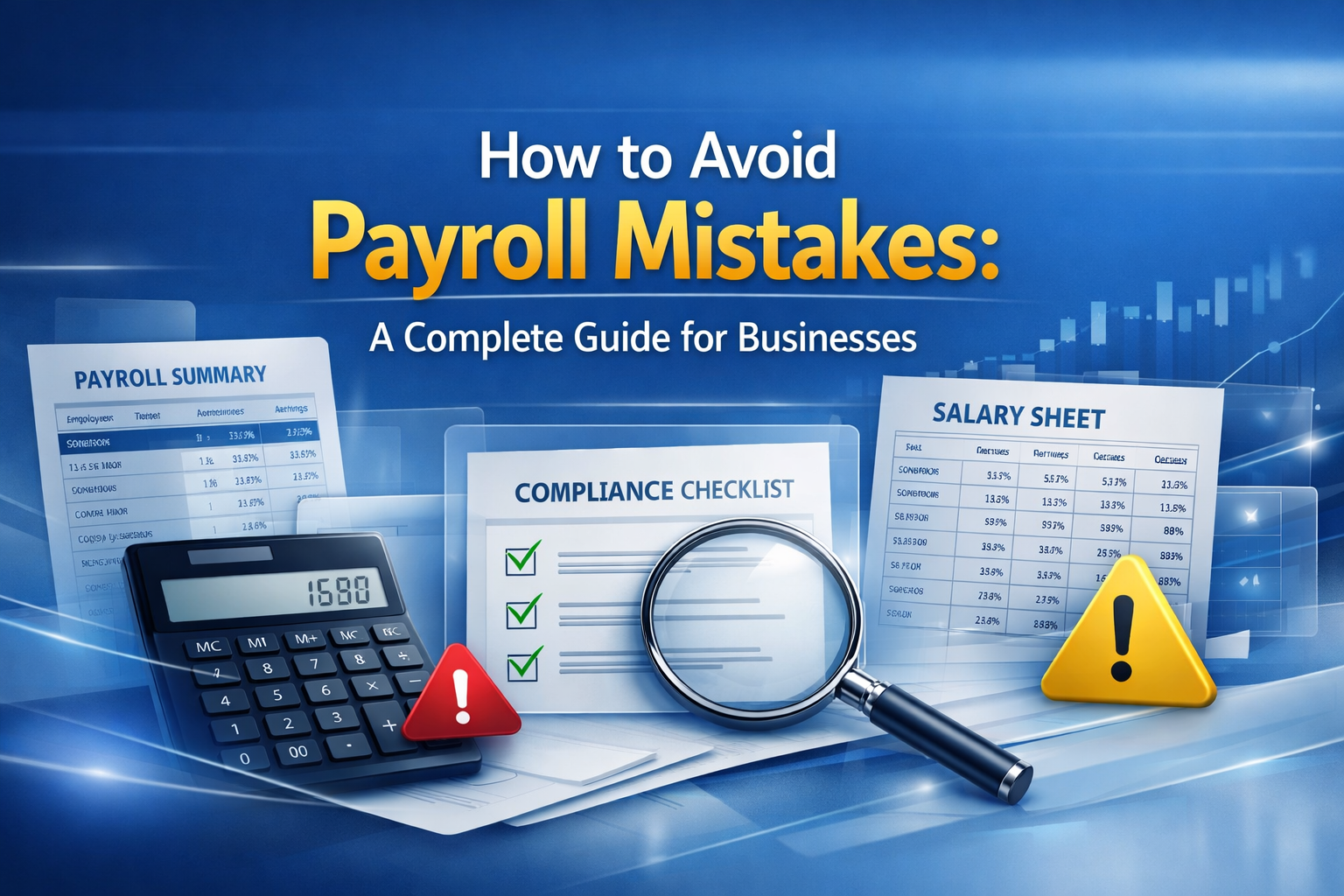
How to Avoid Payroll Mistakes: A Complete Guide for Businesses in India
Payroll errors are never mere bookkeeping tricks. In India, they can give rise to employee disputes, mismatches in taxation, defaults in contribution for social security benefits, penalties when found on audit and damage to staff reputation. When it comes to the payment of salaries, HR managers, employers, payroll teams and compliance heads have a lot more to deal with than just calculating correct paycheques. It also streamlines wages, deductions, attendance, reimbursements, and statutory filings into a single reliable workflow. Manual spreadsheets and fragmented approvals can mean businesses only discover problems once salaries have been processed. An even better way is to structure payroll around documented controls, approval matrices, and accountable review layers that are performed in-house or by specialized payroll services. This guide details how businesses in India can prevent payroll errors – through legal clarity, process discipline, and practical controls. That includes regulatory background, employee coverage, cost implications, documentation, review checkpoints, common compliance failures, and operational habits that minimize errors month after month.
Featured Snippet: How can businesses avoid payroll mistakes in India?
Standardizing salary structures, accurately tracking attendance, validating statutory deductions keeping complete employee records reviewing payroll before release and monitoring changes in tax and labour rules can help businesses in India avoid payroll mistakes. A controlled payroll process minimizes disputes on salary, better compliance, and protects employers against penalties that can be avoided.
What is Payroll Error Prevention?
Payroll error prevention is the discipline of designing payroll operations so that salary calculations, deductions, statutory remittances, records, and employee communications remain accurate and compliant every cycle. It is not limited to running software. It includes policy design, inputs, approvals, reconciliations, documentation, and legal oversight.
Why payroll mistakes happen
Most payroll errors begin before payroll day. Wrong attendance inputs, outdated salary structures, missing employee declarations, incorrect tax assumptions, or delayed communication from HR often flow directly into final salary output. The payroll team is then forced to fix errors under time pressure.
Why prevention matters more than correction
Once salaries are released, recovering excess payments, revising tax deductions, or correcting social security contributions becomes operationally sensitive. Employees lose confidence quickly when take-home pay fluctuates without clear explanation. Preventive controls are therefore far less costly than post-payroll corrections.
Legal Framework / Regulatory Background
Payroll compliance in India sits at the intersection of labour law, social security law, and direct tax administration. Employers must align payroll with wage payment rules, employee benefits, and statutory deductions. Many day-to-day payroll obligations still operate through legacy enactments and current notifications, while businesses also prepare for broader labour code implementation and related wage-definition changes.
Core compliance areas payroll teams must monitor
- Salary payment timelines and wage records
- Provident fund obligations where applicable
- Employee State Insurance applicability and deductions
- Tax deduction at source on salaries
- Professional tax in applicable states
- Bonus, gratuity, leave encashment, and final settlement rules
- State-specific Shops and Establishments requirements
Why regulatory overlap creates risk
Payroll does not fail only when numbers are wrong. It fails when data used for pay is inconsistent with employment contracts, attendance records, tax declarations, reimbursement policies, or state-specific compliance requirements. That is why many growing companies combine payroll with broader governance support through HR outsourcing solutions that create a single control environment for employee lifecycle management.
Legal caution for employers
Employers should avoid assuming that one national rule covers every payroll scenario. Minimum wage notifications, leave rules, professional tax slabs, holiday requirements, and establishment-level obligations may differ based on state, employee category, and business structure. Payroll teams must therefore maintain a live compliance matrix rather than rely on one-time setup.
Eligibility / Coverage
One of the biggest payroll mistakes is treating all workers the same. Payroll compliance depends on who the worker is, what benefits are contractually promised, where the establishment operates, and whether statutory thresholds are met.
Categories that affect payroll treatment
- Permanent employees
- Probationary employees
- Contract staff engaged through third parties
- Part-time employees
- Consultants and retainers
- Remote employees working across states
- Employees eligible for PF, ESI, bonus, gratuity, or PT
Where employers commonly go wrong
Problems arise when businesses copy a salary template from one employee to another without checking grade, location, statutory eligibility, or employment status. Misclassification can distort PF treatment, tax withholding, bonus eligibility, reimbursement handling, and full-and-final settlement calculations.
Practical rule
Before any employee is moved into payroll, HR should validate appointment terms, compensation break-up, location, reporting manager, cost centre, tax regime preference where relevant, bank details, and statutory enrollment status. Coverage decisions should be documented, not assumed verbally.
Financial Structure / Contribution / Cost Impact
Payroll accuracy directly affects labour cost forecasting. An employer that underestimates statutory cost, overtime exposure, arrears, variable pay treatment, or leave encashment liability will not only face payroll mistakes but also budget distortion.
What payroll cost actually includes
- Gross salary and fixed monthly components
- Employer contributions toward social security where applicable
- Bonuses, incentives, commissions, and variable pay
- Overtime, shift allowance, and attendance-linked earnings
- Reimbursements and taxable perquisites
- Separation payments and notice pay adjustments
Why salary structure design matters
A poorly designed salary structure can create compliance exposure. For example, when allowances are inflated without checking statutory wage definitions or when variable components are left undocumented, businesses may struggle during inspections, employee disputes, or internal audits.
Cost impact of recurring payroll errors
Even small mistakes can become expensive when repeated. A missed deduction for several months, an incorrect tax estimate, or unpaid overtime across teams can result in arrears, interest, rework, and damaged employee trust. Payroll should therefore be treated as a financial control function, not merely an administrative routine.
Step-by-Step Process
1. Standardize the payroll calendar
Fix the cut-off for attendance, leave, reimbursement claims, joining data, exits, variable pay approvals, and statutory validations. Everyone involved should know the calendar. Payroll errors increase sharply when inputs continue changing after the cut-off date.
2. Capture attendance from a reliable source
Attendance is often the first broken input in payroll. Manual attendance sheets, late regularizations, and inconsistent shift coding can distort salary, overtime, and leave deductions. A stable time and attendance system reduces dependency on email-based approvals and improves traceability.
3. Validate master data before every run
Check salary revisions, new joinees, exits, leave without pay, bank details, tax declarations, and benefit enrollments. Master data changes must be version-controlled and approved.
4. Reconcile earnings and deductions
Compare current month payroll with the previous month. Large unexplained deviations in net pay, tax, overtime, or deductions should be investigated before salary release.
5. Perform statutory review
Before disbursement, verify whether PF, ESI, professional tax, TDS, bonus, and other required deductions or employer-side computations have been captured correctly for eligible employees.
6. Release payroll with documented approval
Payroll should not move from preparation to payment without maker-checker review. Approval should come from authorized HR, finance, or compliance personnel according to delegation rules.
7. Archive records and file on time
After processing, store payroll registers, bank advice, payslips, reimbursement proofs, deduction reports, and statutory working papers in one controlled repository.
Documentation Checklist
Incomplete records are a hidden payroll risk. When employee data or supporting documents are missing, payroll teams compensate by making assumptions. That is where errors begin.
Employee onboarding records
- Offer letter and appointment letter
- Identity and address proof
- PAN, Aadhaar, and bank details as applicable
- UAN, ESI details, and prior employment information where relevant
- Compensation structure approval
- Location, department, and reporting details
Monthly payroll records
- Attendance and leave summary
- Overtime or shift approval
- Reimbursement claims and proofs
- Incentive and bonus approval sheets
- Tax declaration updates and investment proofs
- Payroll register and bank transfer file
Best way to maintain records
Businesses should keep these records in structured digital workflows, especially when teams work across multiple locations. Centralized cloud-based HR services improve accessibility, audit readiness, and version control without depending on scattered email attachments or local folders.
Common Mistakes & Compliance Risks
Incorrect employee master data
Wrong date of joining, salary break-up, tax status, bank account, or statutory code leads to direct payment and filing errors. This is one of the most preventable payroll failures.
Improper handling of leave and attendance
Unapproved leave reversals, missing late marks, and poor shift records can distort net salary. When payroll depends on outdated attendance data, even a correct formula produces a wrong result.
Wrong tax deduction assumptions
Employers often deduct too little because declarations are incomplete or too much because payroll ignores exemptions, regime choices, or revised projections. Both outcomes frustrate employees and create year-end correction pressure.
Statutory deduction errors
PF, ESI, PT, and other deductions must be checked for applicability and accuracy. Errors here do not stay internal; they affect filings, challans, employee records, and inspection exposure.
Poor full-and-final settlement controls
Exit payroll is high-risk because leave balance, notice recovery, gratuity, incentives, bonus, expense claims, and asset clearance all intersect. Weak coordination between HR, payroll, admin, and finance creates avoidable disputes.
No maker-checker review
A single-person payroll process may seem fast, but it increases the risk of unnoticed errors, unauthorized changes, and weak audit defensibility. Segregation of duties is essential even in smaller organizations.
Employer/HR Practical Checklist
Employers can reduce payroll mistakes dramatically by using a simple operational checklist every month.
- Freeze attendance and leave inputs by a documented cut-off date.
- Confirm new joinees, exits, salary revisions, and variable pay approvals.
- Review deductions for PF, ESI, PT, loans, advances, and tax.
- Compare current net pay against prior month variances.
- Check statutory filing dates and payment obligations.
- Approve payroll through a maker-checker workflow.
- Release payslips with clear earnings and deduction break-up.
- Maintain a post-payroll reconciliation and issue log.
For scaling businesses, payroll becomes more reliable when the checklist is embedded into the operating model rather than remembered manually. That is where a structured partner such as payroll operations partner can help align systems, approvals, and compliance accountability.
Comparison Table
| Payroll Area | Common Mistake | Business Impact | Prevention Control |
|---|---|---|---|
| Attendance | Using incomplete or late attendance data | Wrong salary, overtime, and leave deductions | Freeze cut-off and validate source records |
| Employee Master Data | Incorrect salary, bank, or statutory details | Payment failure and compliance errors | Monthly master data audit with approvals |
| Tax | Ignoring declarations or updated projections | Under-deduction or employee dissatisfaction | Quarterly tax review and declaration tracking |
| Statutory Compliance | Wrong deduction or late remittance | Interest, penalty, inspection risk | Compliance calendar and pre-payroll validation |
| Full & Final Settlement | Missing leave, notice pay, or benefits | Exit disputes and delayed closure | Standard exit checklist across departments |
Future Outlook / Recent Amendments
Payroll compliance in India is becoming more system-driven, more document-dependent, and more sensitive to wage classification. Businesses should expect continued attention on digital records, clean audit trails, and stronger alignment between employment terms and payroll output.
What employers should watch closely
- Changes linked to labour code implementation and wage definitions
- State-level updates to minimum wages and professional tax rules
- Annual tax changes affecting payroll withholding
- Greater scrutiny of contractor versus employee classification
- Higher expectations for digital documentation and payroll traceability
Strategic takeaway
The future of payroll in India is not just automation. It is controlled automation. Businesses that combine accurate data, documented processes, and current legal monitoring will be far better positioned than those that treat payroll as a back-office afterthought.
FAQ
What is the most common payroll mistake in Indian businesses?
The most common mistake is processing payroll with incorrect input data, especially attendance, leave, salary revisions, and tax declarations. When source data is wrong, the final payroll output also becomes unreliable.
How often should payroll data be audited?
Critical payroll fields should be reviewed every month before salary release. A deeper compliance and process audit should also be scheduled periodically, especially after policy changes, system migration, or rapid headcount growth.
Can payroll mistakes lead to legal penalties?
Yes. Mistakes involving statutory deductions, tax withholding, late remittances, or inaccurate records can lead to interest, penalties, employee claims, and audit issues. The risk is higher when the employer has poor documentation.
Should small businesses use formal payroll controls?
Absolutely. Smaller businesses are often more exposed because one person may handle HR, payroll, and finance inputs together. Even simple controls such as approval workflows, checklists, and reconciliations can significantly reduce error risk.
Conclusion
Avoiding payroll mistakes in India requires more than payroll software. It requires disciplined inputs, clear salary structures, statutory awareness, accurate attendance capture, timely documentation, and maker-checker accountability. When employers build payroll as a controlled business process, they reduce disputes, improve employee confidence, and stay better prepared for audits and regulatory scrutiny. For organizations that want to strengthen accuracy and compliance without overloading internal teams, a practical next step is to evaluate professional support through specialized HR process support that aligns payroll operations with business growth.