
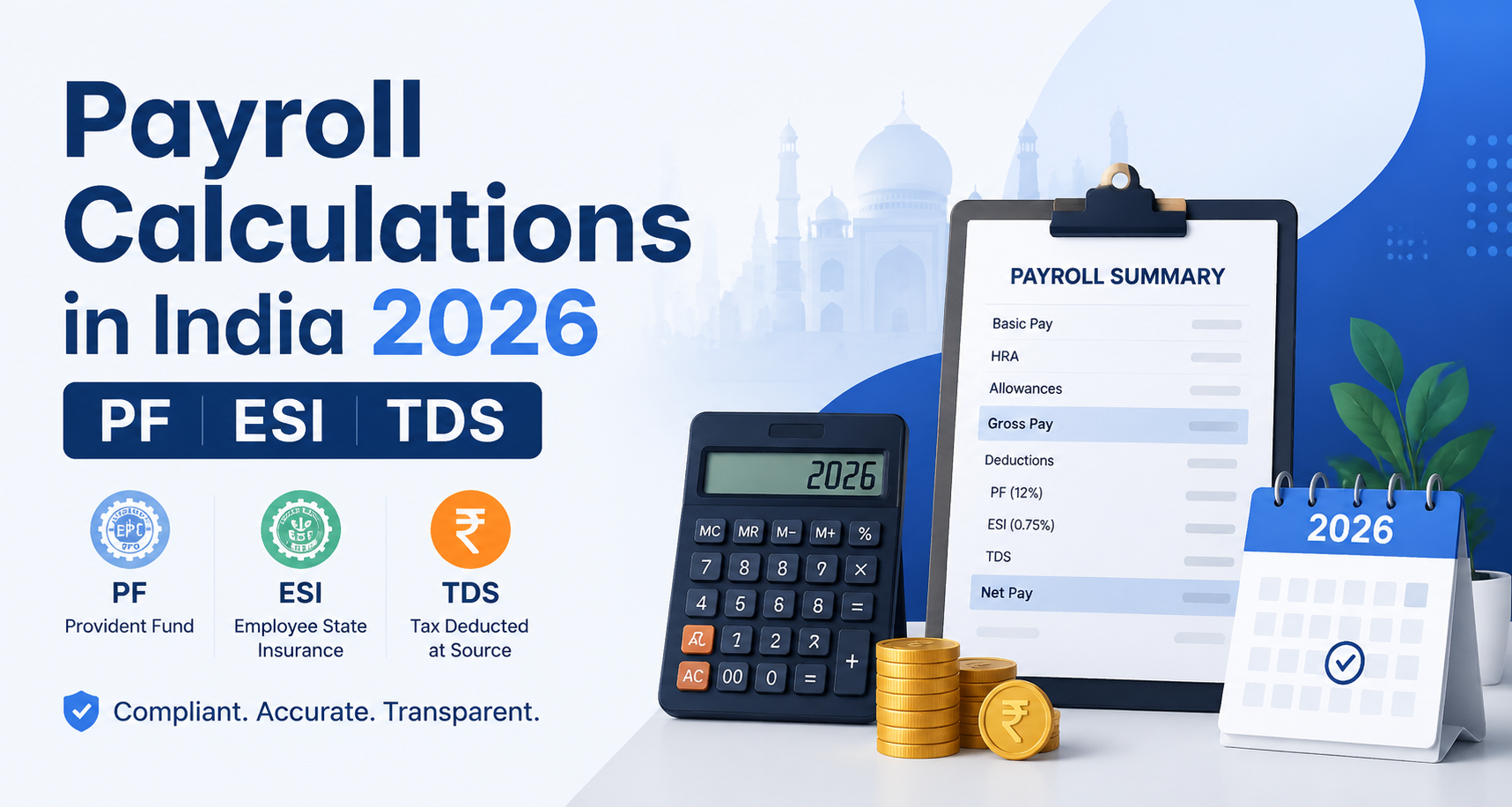
Payroll calculations look simple on the surface: calculate salary, deduct taxes, and release payment. In reality, payroll is one of the most sensitive finance and HR functions in any organization.
A single payroll cycle may involve attendance changes, leave without pay, overtime, incentives, reimbursements, PF, ESI, professional tax, TDS, salary arrears, and full-and-final settlements. When even one element is handled incorrectly, employees lose trust and businesses face compliance risk.
Payroll calculations are the process of determining an employee’s payable salary by calculating earnings, statutory deductions, taxes, reimbursements, employer contributions, and final net pay for a given payroll period.
In 2026, payroll teams in India also need to work through a changing compliance environment. The Income Tax Act, 2025 became effective from 1 April 2026 for Tax Year 2026–27 onward, while salary TDS for earlier periods continues to follow the previous framework where applicable.
What Are Payroll Calculations?
Payroll calculations determine how much an employee should receive after considering salary structure, attendance, leave, variable earnings, statutory deductions, tax deduction, and other recoveries.
Payroll Calculations:
The structured process of converting an employee’s agreed compensation into actual monthly payable salary, net take-home pay, statutory deductions, and employer payroll cost.
Key Takeaway
Payroll is not merely salary disbursement. It is a combination of:
- HR data
- Attendance data
- Salary structure
- Tax logic
- Statutory compliance
- Accounting accuracy
Why Payroll Accuracy Matters in 2026?
Accurate payroll protects employee trust, prevents compliance errors, improves financial control, and helps businesses adapt to India’s evolving tax and labour environment.
Payroll mistakes are rarely seen as “small” by employees. A missed incentive, wrong PF deduction, incorrect unpaid leave adjustment, or unexplained tax cut can quickly damage confidence in the employer.
From a business perspective, payroll accuracy matters because it affects:
| Area | Why It Matters |
|---|---|
| Employee trust | Salary disputes reduce morale |
| Compliance | Incorrect PF, ESI, TDS, or wage treatment can create liability |
| Cash flow | Payroll is one of the largest recurring business expenses |
| Audit readiness | Payroll records support statutory filings and internal controls |
| HR credibility | Transparent payslips reduce escalations |
2026 Compliance Context
India’s payroll environment is becoming more digitally structured. The Ministry of Labour and Employment’s 2026 employer handbook presents a direction of compliance simplification under the four labour codes, including single electronic returns, fewer forms, and fewer registers, subject to the applicable notified rules and legal framework.
At the same time, salary planning remains cost-sensitive. EY’s Future of Pay 2026 projects average salary increments in India at 9.1% in 2026, compared with 9.3% in 2025, pointing toward tighter compensation control and more targeted pay decisions.
Practical Insight
Taken together, these signals suggest that payroll teams are expected to do two things well in 2026:
- Keep compensation calculations commercially disciplined
- Maintain cleaner, more audit-ready compliance records
Core Payroll Terms Every HR and Finance Team Should Know
Before calculating salary, payroll teams must clearly distinguish between CTC, gross pay, net salary, deductions, taxable salary, and employer contributions.
| Term | Meaning |
|---|---|
| CTC | Cost to Company; total annual employment cost |
| Gross Salary | Salary before employee deductions |
| Net Salary | Take-home salary after deductions |
| Basic Salary | Core fixed component often used for PF and other calculations |
| Allowances | HRA, special allowance, conveyance, shift allowance, etc. |
| Variable Pay | Incentives, commission, performance bonus |
| Statutory Deductions | PF, ESI, TDS, professional tax where applicable |
| Non-Statutory Deductions | Loan recovery, advances, voluntary deductions |
| Employer Contributions | Employer PF, employer ESI, gratuity provision, etc. |
| Payable Days | Days for which salary is earned in the payroll month |
CTC vs Gross Salary vs Net Salary
A common payroll confusion is treating these three as interchangeable. They are not.
| Item | Includes |
|---|---|
| CTC | Gross salary + employer contributions + benefits |
| Gross Salary | Earnings before employee deductions |
| Net Salary | Final take-home after deductions |
Simple Example
If an employee has:
- Gross monthly salary: ₹50,000
- Employee PF: ₹1,800
- TDS: ₹2,500
- Professional tax: ₹200
Then:
Net Salary = ₹50,000 – ₹1,800 – ₹2,500 – ₹200 = ₹45,500
Payroll Calculation Formula
The basic payroll formula is:
Net Pay = Gross Payable Earnings – Statutory Deductions – Other Deductions
A more complete formula is:
Net Salary = Fixed Earnings + Variable Earnings + Arrears + Reimbursements – LOP Deduction – Statutory Deductions – Other Recoveries
Payroll Cost Formula for Employers
Total Payroll Cost = Gross Salary + Employer PF + Employer ESI + Other Employer Benefits/Provisions
This distinction is crucial. Employees care about net salary, but businesses must manage total payroll cost.
Step-by-Step Payroll Calculation Process
Payroll should be calculated in a structured sequence: collect inputs, calculate payable earnings, apply deductions, compute TDS, verify employer cost, and generate payslips and compliance outputs.
Step 1: Collect Payroll Inputs
Before any calculation begins, payroll should receive the correct monthly input file.
Typical Payroll Inputs
- Employee master data
- Date of joining or exit
- Salary structure
- Attendance records
- Paid leave and unpaid leave
- Overtime hours
- Incentives and commissions
- Reimbursements
- Bonus or arrears
- Loan or advance recoveries
- Tax declarations and investment proofs
- Changes in bank details, tax regime, or employee category
Expert Tip
Payroll accuracy is usually decided before calculation begins. A clean input file eliminates most downstream corrections.
Step 2: Determine Payable Days
If an employee works the full month, salary is straightforward. If they join mid-month, resign, or take unpaid leave, salary must be prorated.
Formula
Prorated Salary = Monthly Salary × Payable Days ÷ Total Days in Payroll Month
Example
Monthly gross salary = ₹60,000
Total days in month = 30
Payable days = 27
Prorated gross salary = ₹60,000 × 27 ÷ 30 = ₹54,000
Step 3: Calculate Gross Payable Earnings
Gross pay includes all earnings due for the payroll month.
Earnings May Include
- Basic salary
- Dearness allowance, where applicable
- HRA
- Special allowance
- Shift allowance
- Overtime pay
- Incentive
- Sales commission
- Arrears
- Bonus, where payable
- Reimbursements, based on policy
Example Gross Pay Table
| Component | Amount |
|---|---|
| Basic Salary | ₹20,000 |
| HRA | ₹10,000 |
| Special Allowance | ₹8,000 |
| Incentive | ₹3,000 |
| Reimbursement | ₹1,000 |
| Gross Payable Earnings | ₹42,000 |
Step 4: Calculate Statutory Deductions
Common statutory payroll deductions in India include:
- Provident Fund
- ESI, if applicable
- TDS on salary
- Professional tax, where applicable
- Labour welfare fund, where applicable
These should not be calculated blindly. Each deduction follows its own wage base, threshold, frequency, and legal applicability.
Step 5: Calculate Non-Statutory Deductions
These depend on internal policy or employee authorization.
Examples include:
- Salary advance recovery
- Staff loan EMI
- Canteen recovery
- Asset recovery
- Insurance top-up
- Voluntary contributions
Such deductions should be supported by policy, consent, or legally permitted recovery logic.
The Ministry’s 2026 labour code handbook also emphasizes that wage deductions must remain authorized and, under the Code on Wages framework described there, should not exceed 50% of wages during a wage period. Payroll teams should apply this carefully based on the law and rules applicable to their establishment.
Step 6: Calculate Net Salary
Once earnings and deductions are ready:
Net Salary = Gross Earnings – Total Employee Deductions
Example
| Description | Amount |
|---|---|
| Gross Earnings | ₹42,000 |
| PF | ₹1,800 |
| ESI | ₹0 |
| TDS | ₹2,200 |
| Professional Tax | ₹200 |
| Loan Recovery | ₹1,000 |
| Net Salary | ₹36,800 |
Step 7: Calculate Employer Cost
Employer cost is different from employee take-home pay.
It may include:
- Employer PF
- Employer ESI
- Gratuity provision
- Bonus provision
- Insurance cost
- Employer NPS contribution, where applicable
- Other structured benefits
Why This Matters
Finance teams budget payroll using employer cost, not just net pay.
Step 8: Generate Payslips, Journals, and Compliance Outputs
After final validation, payroll should generate:
- Employee payslips
- Bank transfer file
- Payroll register
- General ledger entries
- PF contribution files
- ESI contribution data
- TDS working
- Tax reports
- Variance report for management review
The labour code handbook also describes maintaining payroll-related records such as attendance registers, wage registers, overtime registers, and wage slips in prescribed form, with the option of electronic maintenance where applicable.
Statutory Payroll Deductions in India
The most important recurring payroll deductions in India are PF, ESI, TDS, professional tax where applicable, and certain state-specific contributions or recoveries.
1. Provident Fund Calculation
PF is generally calculated as a percentage of eligible PF wages, subject to statutory rules and wage ceilings.
According to EPFO’s contribution guidance:
- Employee contribution is generally 12% of PF wages
- Employer contribution is also generally 12%
- Contributions are ordinarily payable up to the statutory wage ceiling of ₹15,000
- Certain establishments may fall under a 10% statutory contribution rate
- EPS contribution is carved out of the employer’s share where applicable
Simple PF Example
PF wages = ₹15,000
Employee PF = 12% of ₹15,000 = ₹1,800
Employer PF-related cost also totals ₹1,800 in a standard 12% case, though the internal split between EPF and EPS depends on eligibility and scheme rules.
Expert Tip
Do not use the employee’s CTC as the PF base. PF calculation must follow the legally relevant wage base and the employer’s adopted contribution policy.
2. ESI Calculation
ESI applies to eligible employees within the wage coverage limit and is calculated on applicable wages.
ESIC states that:
- Employee contribution: 0.75%
- Employer contribution: 3.25%
- Existing wage limit for coverage: ₹21,000 per month
- Wage limit for persons with disability: ₹25,000 per month
Simple ESI Example
Monthly applicable wages = ₹20,000
- Employee ESI = 0.75% × ₹20,000 = ₹150
- Employer ESI = 3.25% × ₹20,000 = ₹650
Practical Reminder
ESI should be checked carefully during salary revisions, new joiner processing, and monthly threshold validation.
3. Professional Tax
Professional tax is a payroll deduction applied where the relevant state law requires it.
Professional tax is not uniform across India. Its slabs, thresholds, payment frequency, and return requirements depend on the applicable state legislation. Payroll software and manual payroll sheets should therefore be configured by employee work location and state applicability.
4. Labour Welfare Fund
Labour Welfare Fund contributions apply in certain states and may involve employee and employer contributions according to the relevant state rules.
These deductions are commonly missed when payroll expands to new states or when companies move from one-office operations to distributed teams.
TDS on Salary in 2026: What Employers Must Understand
Salary TDS in 2026 should be calculated using the correct tax law for the payment period, the employee’s applicable regime or option, projected annual taxable income, permitted deductions, surcharge if relevant, and cess.
What Changed in 2026?
The Income Tax Department states that:
- The Income Tax Act, 2025 is effective from 1 April 2026
- Tax Year 2026–27 onward falls under the new Act
- Salary paid for April 2026 onward is governed by the new Act for TDS timing purposes
- Prior-year salary and related compliance remain linked to the earlier Act where applicable
Default Individual Tax Rates for Tax Year 2026–27
The Finance Bill memorandum states that the default rates under section 202 for Tax Year 2026–27 are:
| Total Income | Tax Rate |
|---|---|
| Up to ₹4,00,000 | Nil |
| ₹4,00,001 to ₹8,00,000 | 5% |
| ₹8,00,001 to ₹12,00,000 | 10% |
| ₹12,00,001 to ₹16,00,000 | 15% |
| ₹16,00,001 to ₹20,00,000 | 20% |
| ₹20,00,001 to ₹24,00,000 | 25% |
| Above ₹24,00,000 | 30% |
The memorandum also states that these rates apply by default unless an option is exercised under the relevant provision, and that Health and Education Cess remains 4% on computed tax, inclusive of surcharge where applicable.
How Payroll Teams Usually Approach TDS
A practical payroll tax workflow generally includes:
- Project annual salary
- Add taxable bonuses, incentives, arrears, and perquisites where relevant
- Consider regime selection or applicable option
- Apply eligible deductions or exemptions based on declarations and proofs
- Compute annual tax liability
- Reduce tax already deducted
- Spread the remaining tax across upcoming payroll months
Common Question
Why does TDS suddenly increase in January, February, or March?
Because payroll teams often true up tax liability after receiving investment proofs, bonus payouts, salary revisions, or updated declarations.
Worked Payroll Calculation Example
A payroll calculation becomes clearer when earnings, deductions, and employer contributions are shown side by side.
Scenario
An employee has the following monthly salary:
| Component | Amount |
|---|---|
| Basic Salary | ₹10,000 |
| HRA | ₹4,000 |
| Special Allowance | ₹5,000 |
| Conveyance/Other Pay | ₹1,000 |
| Gross Monthly Earnings | ₹20,000 |
Assumptions:
- Full attendance
- Employee is within ESI coverage wage limit
- PF applies on ₹10,000 basic wages
- TDS and professional tax are excluded from this simplified illustration
Employee Deduction Calculation
| Deduction | Formula | Amount |
|---|---|---|
| Employee PF | 12% of ₹10,000 | ₹1,200 |
| Employee ESI | 0.75% of ₹20,000 | ₹150 |
| Total Deductions | ₹1,350 |
Net Salary
| Description | Amount |
|---|---|
| Gross Earnings | ₹20,000 |
| Total Deductions | ₹1,350 |
| Net Salary Before PT/TDS | ₹18,650 |
Employer Contribution
| Employer Cost Item | Amount |
|---|---|
| Employer PF | ₹1,200 |
| Employer ESI | ₹650 |
| Total Employer Statutory Contribution | ₹1,850 |
Total Monthly Employer Payroll Cost
₹20,000 + ₹1,850 = ₹21,850
This example shows why employee take-home pay and employer payroll cost are not the same thing. PF and ESI rates in the illustration are based on current official EPFO and ESIC guidance.
Payroll Calculations for Special Scenarios
Payroll becomes complex when employee circumstances change mid-cycle. A good payroll process must handle joining, exit, leave, overtime, arrears, and variable pay correctly.
1. New Joiners
If an employee joins on the 11th of a 30-day month:
Payable Salary = Monthly Salary × 20 ÷ 30
Payroll should also check:
- PF applicability from joining date
- ESI eligibility
- Tax projection based on remaining annual income
- Pro-rated allowances, if policy allows
2. Resignations and Full-and-Final Settlement
Final payroll may include:
- Salary till last working day
- Leave encashment, where applicable
- Notice pay recovery or payout
- Bonus or incentive settlement
- Loan/advance recovery
- Tax adjustment
- Reimbursement closure
The 2026 labour code handbook describes, under the Code on Wages framework, payment of due wages within two working days when an employee leaves employment. Employers should verify applicability and current notified rules before operationalizing timelines.
3. Leave Without Pay
LOP reduces payable gross earnings.
Example
Monthly salary = ₹45,000
Total calendar days = 30
LOP days = 2
LOP Deduction = ₹45,000 × 2 ÷ 30 = ₹3,000
Payable Gross Salary = ₹42,000
4. Overtime
Overtime calculation should follow applicable law, establishment policy, and wage definition.
The Ministry’s labour code handbook states that, under the Code on Wages framework, employees covered by a notified minimum wage must receive overtime for extra hours at a rate of at least twice the normal wage.
5. Arrears
Arrears may arise due to:
- Retrospective salary increments
- Delayed incentive approval
- Grade correction
- Revised allowance eligibility
- Attendance correction from previous months
Payroll should identify:
- The earning month
- The payment month
- Tax impact
- Statutory deduction impact
- Accounting treatment
6. Bonuses and Variable Pay
Variable pay should be treated carefully because it can affect:
- Tax deduction
- Gross payroll cost
- Statutory wage interpretation in certain cases
- Bonus accruals
- Employee expectations
The labour code handbook describes annual bonus provisions under the Code on Wages framework as a minimum of 8.33% and maximum of 20% of wages earned, subject to eligibility and applicable notified limits.
Common Payroll Calculation Mistakes
Most payroll errors occur because teams use the wrong base, skip prorations, mishandle tax true-ups, or ignore compliance configuration.
| Mistake | Why It Creates Risk | Better Practice |
|---|---|---|
| Treating CTC as monthly payable salary | Inflates employee expectation | Separate CTC, gross, and net clearly |
| Applying PF on the wrong amount | Causes statutory or policy inconsistency | Define PF wage base correctly |
| Missing ESI eligibility checks | Leads to wrong deductions | Validate wage thresholds monthly |
| Treating TDS as a flat fixed amount | Creates under- or over-deduction | Use annualized tax projection |
| Ignoring LOP impact | Overpays salary | Reconcile attendance before payroll |
| Delaying arrears logic | Creates employee disputes | Use proper prior-period adjustment tracker |
| No maker-checker review | Increases error probability | Build payroll approval workflow |
| Not reconciling payroll with GL | Distorts finance records | Perform monthly payroll accounting reconciliation |
| Weak exit payroll process | Creates F&F disputes | Use standardized separation checklist |
| Manual state compliance tracking | Misses location-based deductions | Configure HRMS/payroll system carefully |
Expert Payroll Checklist for HR and Finance Teams
A strong payroll review checklist improves accuracy before salaries are released.
Monthly Payroll Review Checklist
- New joiners added correctly
- Exits and last working dates updated
- Salary revisions uploaded
- Attendance and LOP validated
- Incentives approved
- Reimbursements verified
- PF and ESI applicability checked
- TDS updated for declarations, bonuses, or proof changes
- Loan recoveries reviewed
- Bank file totals matched with payroll register
- Payslips reviewed for unusual movements
- GL entries reconciled with finance records
Expert Tip
Create a variance report comparing the current month’s payroll with the previous month. Any unusual increase or decrease should be explained before bank upload.
Future Trends in Payroll Calculations
Payroll in 2026 and beyond is moving toward automation, integrated HR-finance data, real-time compliance visibility, and more precise handling of variable pay and differentiated compensation.
1. Payroll Will Become More Integrated
Payroll is increasingly tied to:
- Attendance systems
- HRMS
- Leave management
- Claims and reimbursement workflows
- Finance ERP
- Tax declaration portals
- Compliance dashboards
This reduces manual entry and improves traceability.
2. Digital Compliance Will Matter More
The Ministry’s 2026 labour code handbook frames a move toward simpler digital compliance structures, including single electronic returns and fewer forms and registers under the labour code direction of travel.
What This Means Practically
Payroll teams should build systems that can:
- Retain audit trails
- Maintain electronic registers
- Track historical salary revisions
- Store tax declarations and proofs
- Generate compliance-ready data
3. Salary Structuring Will Become More Targeted
EY’s 2026 report points to stable but more selective salary budgeting, with employers using targeted corrections, skill premiums, and performance-led rewards instead of broad-based increases.
Payroll Impact
This makes accurate handling of:
- Variable pay
- Skill allowances
- Performance incentives
- Retention bonuses
- Mid-year salary revisions
even more important.
4. Payroll Automation Will Shift From Convenience to Control
In mature organizations, automation is no longer only about speed. It is about:
- Reducing calculation errors
- Improving audit readiness
- Supporting compliance changes faster
- Managing multi-location payroll rules
- Providing employees with transparent payslip explanations
Conclusion
Payroll calculations are the backbone of employee compensation management. They combine salary design, attendance, tax logic, statutory deductions, employer contributions, compliance discipline, and employee communication.
In 2026, Indian payroll teams need to be especially alert because:
- Salary TDS is operating within the transition to the Income Tax Act, 2025
- PF and ESI rules remain central to monthly payroll accuracy
- Labour compliance is moving toward more digitized and consolidated frameworks
- Compensation structures are becoming more targeted and performance-linked
A payroll process that is accurate, documented, and review-driven does more than pay employees correctly. It protects business credibility.
FAQs on Payroll Calculations
1. What are payroll calculations in simple words?
Payroll calculations are the process of finding an employee’s final salary after adding all earnings and subtracting applicable deductions such as PF, ESI, TDS, and other recoveries.
2. How do you calculate net salary from gross salary?
Use this formula:
Net Salary = Gross Salary – Statutory Deductions – Other Deductions
For example, if gross salary is ₹40,000 and total deductions are ₹4,500, net salary is ₹35,500.
3. Is PF calculated on gross salary or basic salary?
PF is not simply calculated on CTC or total gross salary. It is calculated on eligible PF wages according to applicable EPFO rules and the employer’s contribution structure. EPFO guidance states that contributions are ordinarily payable up to a wage ceiling of ₹15,000, with standard employee contribution generally at 12% and certain exceptions at 10%.
4. When is ESI deducted in payroll?
ESI applies to eligible employees within the prescribed coverage wage limit. ESIC’s current guidance states a wage coverage limit of ₹21,000 per month, or ₹25,000 for persons with disability, with employee contribution at 0.75% and employer contribution at 3.25%.
5. How is TDS calculated on salary in 2026?
Salary TDS is calculated by estimating annual taxable salary, applying the relevant tax regime or option, considering eligible deductions or exemptions, calculating annual tax, and recovering the remaining liability across payroll months. For Tax Year 2026–27 onward, the Income Tax Act, 2025 applies, and the default individual slab structure begins with nil tax up to ₹4 lakh.