
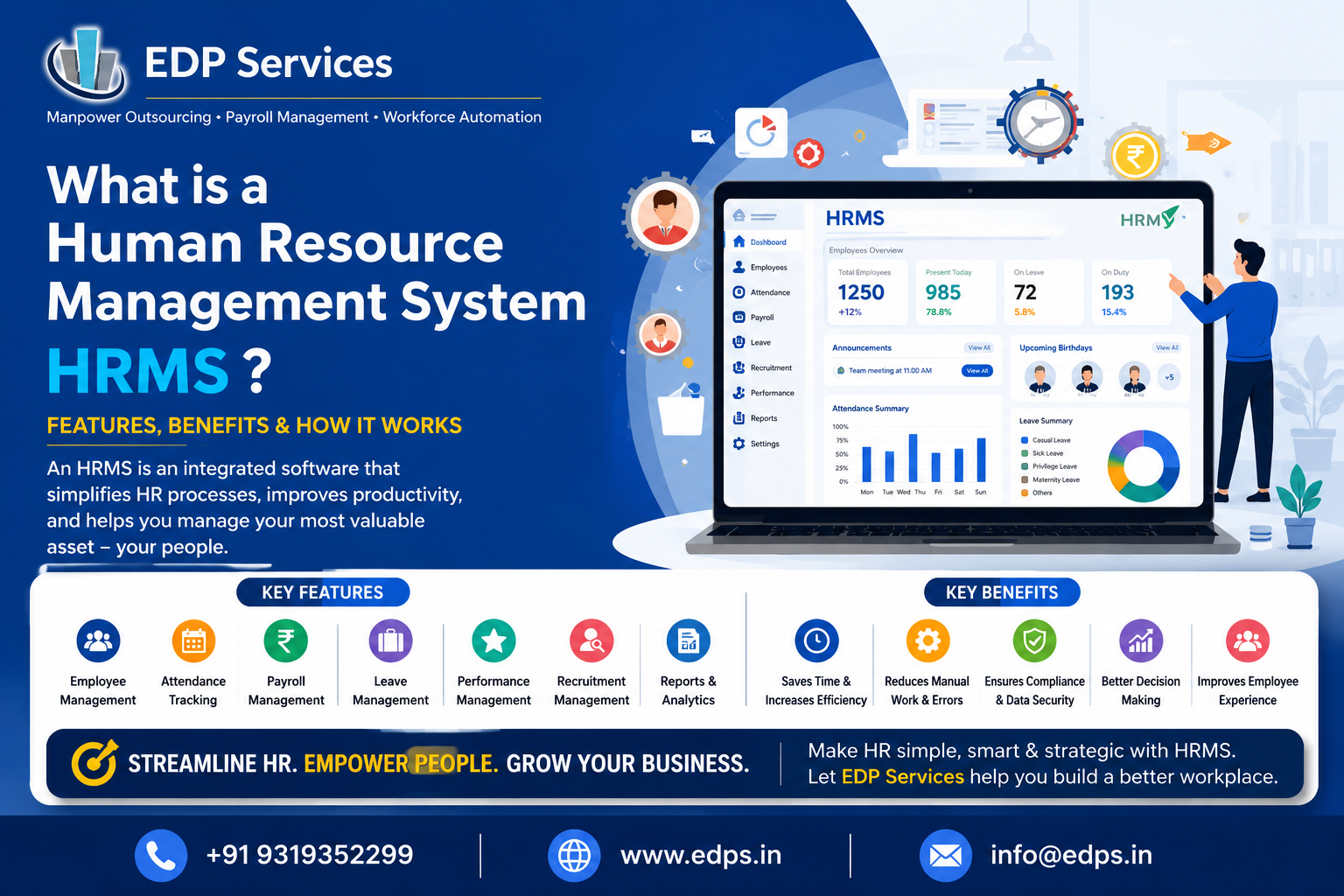
A HRMS (Human Resource Management System) is a technologically-driven system created to automatize and simplify HR procedures. It provides a single platform to handle employee data including payroll, recruiting as well as attendance, performance and much more. Through integrating all HR processes into one platform, HRMS helps businesses improve efficiency, cut down on administrative costs as well as improve the general experience of employees.
HRMS meaning and definition
HRMS is a system of software which assists in the administration and automated HR processes across an organisation. It acts as the central point that HR departments can use to manage various functions which include:
-
Employee records The purpose of this document is to store and maintain specific employee information.
-
Payroll Management Automation of salary processing as well as tax deductions.
-
In-person and Recruitment managing job advertisements as well as applications and the paperwork for new employees.
-
"Performance Management" Monitoring employee performance and giving feedback.
-
Compliance The process of ensuring your company is in compliance with all legislation governing the workplace and other industry rules.
History of Human Resource Management Systems
In the end, HRMS simplifies HR operations and allows businesses to manage their HR resources better.
Human Resource Management Systems (HRMS) has roots dating back to the age old practices of manual HR administration that mainly existed in the first half of the 20th century. There was a time when HR departments are depended on paper-based record management of employee data, attendance, payroll, and recruitment process. These manual systems were tedious, prone to error and extremely difficulty to scale with a growing organization.
The 1960s and 1970s saw the introduction of computers, which led to businesses gradually digitising payroll processes. However, back in the day, Early HR software systems are only limited to basic features which involved automating salary calculation and maintaining employee databases. The start of the HR technology evolution was these systems.
The 1990s witnessed the emergence of advanced Human Resource Information Systems (HRIS) through the combination of several human resource functions, which included attendance tracking, benefits administration and compliance management. From basic automation to taking centralized control of HR data, that transformation happened over this time period.
The 2000s changed everything with cloud computing and HRMS. This allowed organizations to have direct access to HR systems which in return facilitated real-time updates, became better scalable and enhanced data security. Today, the best HRMS platforms combine artificial intelligence (AI), machine learning (ML) and analytics to guide strategic decision making.
Over the years, HRMS has progressed from being an automation system purely focused on payroll and leave tracking to a fully intelligent ecosystem responsible for not only managing day to day HR operations but also contributing towards improving workforce planning, employee engagement and organizational productivity.
How HRMS Has Evolved Over Time
The development of HRMS is influenced by advances in technology that have taken it from paper-based systems to advanced cloud-based solutions. This is a brief look at the development:
-
Manual HR Record The first HR systems were based on paper that required manual recording to keep track of everything from employee details and payroll processing.
-
Basic HR Systems The very first HR software had basic functions like payroll automation and record-keeping for employees.
-
Cloud-based HRMS Platforms for HRMS that are modern have a cloud-based model, allowing immediate access to information, the ability to scale as well as the ability to integrate with other systems in an enterprise.
-
AI as well as Automation the most recent HRMS systems are using the power of artificial intelligence (AI) as well as automation to enhance efficiency, predictability as well as employee engagement.
Who uses HRMS software?
HRMS Software is used for businesses of all sizes and in all industries, from small startups to large multinational corporations. It is designed to support a variety of stakeholders in a company which will usher it into the new way of doing human resources operation to make it more transparent, efficient and accessible.
Human Resource (HR) Teams
HRMS Software = the new easy way of handling HRThe most relevant end-user of any HRMS software will be an HR person. They use it for employee records, recruitment management, attendance and payroll processing, and compliance. HRMS lessens the manual work and in turn, allows teams to spend more time focusing on strategic tasks like employee engagement or workforce planning.
Payroll and Finance Teams
Payroll professionals use these HRMS systems for salary calculation, tax deductions, bonuses other benefits. The system also processes payroll on time and reduces errors often caused by manual calculations. It also helps finance teams to remain compliant with taxation rules and financial regulations.
Managers and Supervisors
HRMS tools are used by the managers to track the performance of employees, approve leave requests, attendance tracking, etc. Providing managers with real-time dashboards and analytics to make better decisions on promotions, training needs, load distribution.
Employees
Some of the self-service functions are also actively used by employees on HRMS portals. The portal with software revolutionizes various HR functions by allowing the employees to access payslips, apply leave, update the personal information like address and phone numbers and track attendance along with viewing company policies. This increases transparency, and decreases reliance on HR departments for routine requests.
Top Management and Executives
HRMS analytics and reporting tools provide even senior leadership teams with an insight into workforce performance, employee turnover rate, hiring patterns, and productivity levels. This is vital information for planning strategic moves and longer-term investment decisions.
Specialists who are on the recruitment or talent acquisition teams
At times HRMS is used by recruiters to post jobs, process applications, screen candidates here too interview and track the hiring pipeline. It makes the whole recruitment life cycle more efficient.
HRMS software is nothing but a single point of information for the entire organization that connects all three levels: top-level managers, mid-level management & bottom level.
Benefits of an HRMS
HRMS software is an essential element that provides several important benefits which greatly enhance the efficiency of HR operations and overall business performance.
HR Automation : One of the biggest advantages involved eliminating the manual work such as payroll, attendance tracking, recruitment and employee record analysis which makes it easier with these automated systems. This provides a time-saving benefit and lets HR teams concentrate on strategizing & planning ahead. One of the other major benefit is higher accuracy. HRMS mitigates errors related to salary calculations, tax deductions and employee data management by minimizing the human intervention in repetitive tasks.
HRMS also promotes employee experience, giving employees self-service access to crucial information like payslips, leave available and company policy etc. This promotes transparency and satisfaction among employees.
It also enhances correct decision-making with the help of real-time reports and analytics. This helps managers and executives analyze the trends in the workforce, productivity levels, and performance of employees efficiently. Automation automates a lot of the administrative work and operational inefficiencies leading to cost reduction is another favorable aspect.
In short, HRMS makes the organization more systematic, productive, employee-friendly besides compliance and operational efficiency.
HRMS Security
HRMS security is an essential part of any Human Resource Management System since a considerable amount of sensitive employee and organizational data is stored. This includes the personal data of all employees, salary information, tax records and performance reports, etc. In fact, this data should not be pried into by everyone.
The modern HRMS platform have a multi-layered security system for data protection. The most common way is based on role, in which users only have access to the data that relates to their position. For instance, users can view their records while HR managers have access to masses of employee data.
The next key aspect of security is data encryption, which ensures that information remains protected while being transmitted and when it is stored. If someone gets access to data, they cannot read it without being authorized.
HRMS system also perform multi-factor authentication (MFA), to agile up the login security. It requires users to confirm their identity using multiple steps including a password and OTP.
Data backups and disaster recovery systems help ensure that information is never lost due to system failure or cyberattack. Cloud HRMS systems usually have greater redundancy and security than traditional/legacy systems.
Adherence to international data protection norms like GDPR or local labor legislations is also a vital part of HRMS security. This is to ensure that the employer treats any data about their employee responsibly and in accordance with the laws.
In summary, security is one of the basic components to keep HRMS up & running on a flawless cycle with ways to protect data while keeping everyone connected.
HRMS vs. HRIS vs. HRCM: What's the Difference?
A lot of people refer to terms such as HRMS, HRIS (Human Resource Information System) and HCM (Human Capital Management) to mean the same thing, yet each has a distinct meaning:
-
HRMS It focuses on coordinating every HR process from recruiting through retirement, which includes payroll, performance management and the compliance.
-
HRIS: The primary focus is employees' data management and records. It's an application for databases to store details about employees.
-
HCM: A broad concept that encompasses all HRMS and HRIS, however it is focused on strategic elements such as managing talent, workforce planning and development of leadership.
The choice of the best option will depend on the requirements of your business. An HRMS can be a great choice for a full and integrated HR management solution.
The importance of HRMS for Modern Companies
An HRMS has many benefits that are essential to companies in the present:
-
Increased efficiency Automation of HR processes can reduce the amount of amount of time that is spent on repetitive tasks and allows HR professionals to concentrate on their strategic goals.
-
enhanced Compliance HRMS aids firms comply with labor law as well as industry regulations, through the tracking and update of the compliance requirements.
-
accuracy and reduced errors Automating reduces the chance of human error when it comes to payroll, attendance and monitoring of performance.
-
Improved Employee Experience Employees gain having easier access to HR data, such as payslips, benefits, and balances of leave.
In the current fast-paced environment of business it is more than a luxury but a necessity.
Who Can Use HRMS Software?
HRMS software is not just helpful to HR departments, but it is also beneficial to other functions within an organisation:
-
HR teams: automate everyday chores, streamline operations and keep track of employee information.
-
Payroll professionals ensure the accuracy and speed of payroll processing.
-
Managers Follow team's performance, control the attendance of employees, and manage demands quickly.
-
Employees can access their personal details, monitor the balance of their leave, and track the benefits they receive with ease.
An HRMS facilitates collaboration among groups and facilitates seamless HR functions throughout the entire organization.
Essential Features of HRMS Software
HRMS software has several essential modules that support the entire process of HR management. The modules are:
-
Payroll Management The program automates calculations for payroll taxes, calculates tax deductions and makes sure that the company is in compliance with tax laws.
-
Time and Attendance tracking monitors employee attendance as well as leave balances and working hours.
-
Recruitment Management of job announcements and applications, as well as interviews and the hiring process.
-
"Performance Management Tracks the performance of employees establishes goals and gives feedback.
-
Compliance assists in ensuring conformity with laws governing labor or safety regulations as well as other HR-related legal obligations.
The features allow HR departments to organize employee data more efficiently and help to ensure the overall efficiency of the organization.
HRMS and the Future of HR Technology
As businesses continue to embrace new technologies, the future of HRMS is closely linked with advancements in automation, data analytics, and artificial intelligence (AI):
-
Automation Tasks that are routine like payroll processing as well as benefits administration and the evaluation of performance are becoming increasingly automatized, which saves time as well as decreasing the chance of the chance of errors.
-
Data Analytics HRMS systems make use of big data to offer valuable insight into worker performance, the rate of turnover, as well as talent gap.
-
AI as well as Machine Learning: AI-powered HRMS systems have improved their decision-making capabilities by providing analytic tools for managing talent as well as employee engagement and the recruitment process.
In the future, HRMS will continue to see more incorporation of AI to help organizations to make better HR-related decisions, and improving customer satisfaction.
As a result, HRMS software has become the foundation of modern-day businesses that allows HR departments to handle their tasks better and improve the overall user experience. Utilizing the best HRMS software, companies are able to position themselves to be successful in the increasingly technological world.