

EPF: Employees’ Provident Fund – Benefits, Contribution Rules & Withdrawal Guide 2026
The Employees’ Provident Fund (EPF) is a government-backed retirement savings scheme that helps salaried employees build long-term financial security through regular contributions from employees and employers. Understanding EPF contributions, interest, withdrawal eligibility, and account management helps employees plan their savings and enables employers to maintain accurate payroll and statutory compliance.
Whether you are an employee checking your PF balance or an HR professional managing monthly payroll, this guide explains the key features of EPF, its benefits, contribution structure, withdrawal options, and essential compliance practices.
What Is the Employees’ Provident Fund (EPF)?
The Employees’ Provident Fund (EPF) is a retirement savings scheme administered by the Employees’ Provident Fund Organisation (EPFO) under India’s social security framework. It is designed to help eligible employees accumulate savings during their working years.
Under the scheme, contributions are deposited into the employee’s provident fund account. The accumulated balance earns interest at the rate declared by the government for the applicable financial year, subject to the scheme’s rules.
EPF is part of a broader social security framework that also includes the Employees’ Pension Scheme (EPS) and the Employees’ Deposit Linked Insurance (EDLI) Scheme.
Key Features of EPF
-
Retirement savings: Builds a financial corpus through regular contributions.
-
Employee and employer contributions: Both parties contribute according to applicable rules.
-
Interest earnings: Eligible balances earn interest at the notified rate.
-
Partial withdrawals: Permitted for specified needs, subject to applicable eligibility conditions.
-
UAN-based account management: Helps employees manage their PF accounts and link employment records.
-
Social security benefits: EPFO schemes provide retirement, pension, and insurance-related benefits, subject to eligibility.
How Does the EPF Scheme Work?
EPF works through regular contributions linked to an employee’s wages. The employer deducts the employee’s applicable PF contribution from salary and deposits it along with the employer’s contribution within the prescribed deadline.
The contributions are recorded against the employee’s PF account and Universal Account Number (UAN), where applicable. The accumulated balance grows through contributions and interest over time.
For example, an employee who contributes regularly over several years can build a retirement corpus without needing to make separate deposits manually. The final balance depends on salary, contribution history, interest rates, withdrawals, and other applicable scheme provisions.
EPF Contribution Rules: Employee and Employer Share
For establishments and employees covered by the standard 12% contribution rate, the employee generally contributes 12% of applicable PF wages. The employer also contributes at the applicable rate, subject to the rules and any permitted exceptions.
The employer’s contribution is allocated according to the applicable EPF and EPS provisions. The pension portion is not simply an additional contribution over and above the employer’s total statutory share.
EPF Contribution Breakdown
| Contribution | General rule |
|---|---|
| Employee contribution | Usually 12% of applicable PF wages |
| Employer contribution | Usually 12% under the standard rate, subject to applicable provisions |
| EPS allocation | A prescribed portion of the employer’s contribution for eligible members, subject to scheme conditions |
| EDLI contribution | Employer-funded contribution under the applicable insurance scheme |
| Administrative charges | Payable by the employer as applicable under EPFO rules |
Important: Actual contributions can differ depending on the establishment category, applicable wage ceiling, employee eligibility, membership status, exemptions, and prevailing notifications. Employers should verify the current EPFO contribution rules before processing payroll.
EPF, EPS, and EDLI: What Is the Difference?
EPF, EPS, and EDLI serve different purposes within the social security framework.
1. Employees’ Provident Fund (EPF)
EPF helps employees accumulate savings for retirement and other permitted needs. The eligible balance generally includes contributions and interest, adjusted for withdrawals and other account transactions.
2. Employees’ Pension Scheme (EPS)
EPS is designed to provide pension benefits to eligible members under the applicable scheme. Pension eligibility and the amount payable depend on factors such as pensionable service, pensionable salary and the relevant EPS rules.
3. Employees’ Deposit Linked Insurance (EDLI)
EDLI provides life insurance-related benefits to eligible employees under the scheme. Benefits are subject to the applicable conditions and limits.
Together, these schemes provide different forms of long-term financial protection for eligible employees and their families.
Major Benefits of EPF for Employees
EPF offers several benefits that can support financial planning throughout an employee’s career.
1. Long-Term Retirement Savings
Regular contributions help employees build savings over time. Since contributions are made throughout employment, EPF can support retirement planning without requiring employees to manage every deposit themselves.
2. Interest on the Accumulated Balance
Eligible PF balances earn interest at the rate declared for the relevant financial year. Over a long period, contributions and interest can help increase the accumulated corpus.
The applicable interest rate may change from year to year, so employees should check official EPFO announcements rather than relying on a fixed rate mentioned in an old article.
3. Employer Contributions
Under applicable rules, the employer also contributes towards the employee’s social security benefits. This helps build the employee’s retirement savings and related entitlements.
4. Permitted Partial Withdrawals
Employees may be able to access part of their eligible PF balance for specified needs, including medical treatment, education, marriage and housing-related expenses. Eligibility, limits, frequency and minimum-balance requirements depend on the rules currently in force.
5. Account Portability Through UAN
The Universal Account Number helps employees manage their PF records across employment changes. Employees should ensure that their UAN, KYC details and employment records are accurate to reduce the risk of delays or claim issues.
6. Pension and Insurance-Related Protection
Eligible members may receive pension benefits under EPS and insurance-related benefits under EDLI, subject to the respective schemes’ conditions.
EPF Withdrawal Rules 2026: When Can You Withdraw PF?
EPF withdrawals generally fall into two broad categories: partial withdrawals or advances for specified needs and final settlement when the member meets the applicable conditions.
The rules and procedures can change. In 2025, the Central Board of Trustees approved a simplified framework for partial withdrawals. In 2026, the EPF Scheme framework also underwent changes. Members and employers should therefore verify the currently applicable scheme provisions and EPFO portal instructions before relying on older withdrawal limits or service requirements.
1. Partial Withdrawal for Medical Treatment
Eligible members may apply for a PF advance for specified medical needs involving themselves or eligible family members, subject to the applicable provisions.
The amount available is determined by the relevant rules. Employees should not assume that the entire account balance, including all contributions and interest, is automatically withdrawable for every medical expense.
2. Withdrawal for Education
PF advances may be permitted for qualifying education-related expenses under the applicable scheme.
The eligible service period, amount, frequency, and other conditions must be checked against the current rules before submitting a claim.
3. Withdrawal for Marriage
Members may be eligible to withdraw a permitted amount for qualifying marriage-related expenses, subject to the scheme’s conditions.
The number of permitted withdrawals and the applicable eligibility requirements should be verified using the current EPFO provisions.
4. Withdrawal for Housing Needs
Eligible members may be able to use their PF savings for specified housing-related purposes, such as purchasing or constructing a house, making eligible improvements or meeting qualifying housing-loan requirements.
The property, ownership, service and withdrawal-limit conditions depend on the applicable provision.
5. Withdrawal During Unemployment
Unemployment-related withdrawal rules differ from partial advances and final settlement. Members should check the currently applicable waiting periods, permitted amount and eligibility conditions before applying.
Do not assume that an employee can automatically withdraw 100% of the PF balance immediately after leaving a job. The rules for accessing part of the balance and receiving final settlement are different.
6. Final PF Settlement
Final settlement may be available when the member meets the conditions specified under the applicable EPF Scheme. The eligibility criteria and waiting periods can differ depending on the circumstances, including retirement and cessation of employment.
Before filing a claim, employees should confirm that their date of exit, bank details, KYC, and other required information are accurate.
Note for readers: The amount available for withdrawal is not necessarily equal to the total PF balance displayed in the passbook. Always check the latest official EPFO rules and the claim options available for your circumstances.
How to Check Your EPF Balance Online
Employees can check their PF balance through official EPFO services, subject to account access and the availability of the relevant facility.
Follow these general steps:
-
Visit the official EPFO member portal.
-
Sign in using your UAN and the required authentication details.
-
Open the passbook or relevant account information service.
-
Select the applicable PF member ID, if multiple records are available.
-
Review employee contributions, employer contributions, interest entries and withdrawals.
Employees should use only official EPFO channels and should never share their password, OTP or sensitive login credentials with unauthorised persons.
How to Transfer Your PF Account When Changing Jobs
When employees change employers, they should ensure that their PF records remain correctly linked to their UAN.
A properly maintained UAN and accurate employment records help support continuity of PF membership and simplify account management.
General steps include:
-
Confirm that the UAN and personal details are correct.
-
Check whether the previous employer’s Date of Exit has been recorded accurately.
-
Complete the required KYC and bank verification, if pending.
-
Use the official EPFO transfer facility when a transfer is required.
-
Track the transfer request and resolve any discrepancies through the appropriate employer or EPFO channel.
Employees should review their passbook after the transfer to confirm that the relevant records and balances have been updated.
Common EPF Problems and How to Avoid Them
Some common PF-related issues arise because employee records are incomplete, inconsistent or not updated on time.
Incorrect Date of Joining or Date of Exit
An incorrect joining or exit date can affect service records, claims and other PF-related processes. Employers should verify these dates against reliable employment documentation.
Incorrect UAN or Personal Details
Differences in names, dates of birth or other personal details may create verification problems. Employees should ensure that their records match the required documents.
Incomplete KYC or Bank Information
Missing or incorrect KYC and bank details can delay account services or claims. Employees should review their profile and follow the official process for updating information.
Delayed or Incorrect PF Contributions
Employers should reconcile payroll records against contribution data before submitting monthly returns. Any discrepancy should be investigated and corrected through the prescribed procedure.
Missing Employment Records
Joining dates, exit dates, wage details and employee identifiers should be maintained consistently. Accurate records help support compliant payroll processing and reduce avoidable errors.
Why EPF Compliance Matters for Employers
EPF compliance is an important responsibility for HR, payroll and finance teams. Employers must maintain accurate employee information, calculate contributions correctly and meet the applicable filing and payment requirements.
A structured payroll process can help organisations:
-
Maintain accurate employee and UAN records.
-
Calculate PF contributions according to applicable rules.
-
Reconcile payroll data with statutory filings.
-
Track joining and exit dates.
-
Identify contribution discrepancies before submission.
-
Maintain records for audits and compliance reviews.
-
Coordinate payroll and HR data more effectively.
Businesses that manage a large workforce may benefit from a clearly documented process for payroll calculations, statutory deductions, employee changes and monthly compliance checks.
For support with workforce administration, payroll processing and HR operations, explore EDP Services.
EPF and Payroll Outsourcing: How Professional Support Helps
Managing payroll involves more than calculating salaries. Organisations must also maintain employee records, apply the relevant statutory deductions, reconcile monthly data and follow applicable compliance deadlines.
Professional payroll support can help businesses organise these activities through a consistent process. Depending on the service scope, support may include payroll calculations, statutory contribution coordination, employee data management, payroll reporting and documentation.
However, employers should continue to review the accuracy of payroll inputs and ensure that statutory obligations are fulfilled under the applicable rules.
Frequently Asked Questions About EPF
1. What is EPF?
EPF stands for Employees’ Provident Fund. It is a retirement savings scheme administered by EPFO that helps eligible employees accumulate savings through contributions and interest.
2. Who is eligible for EPF?
Eligibility depends on the establishment’s coverage, the employee’s circumstances and the applicable EPF provisions. Employers should assess coverage and membership requirements under the rules in force.
3. How much does an employee contribute to EPF?
Under the standard contribution rate, an employee generally contributes 12% of applicable PF wages. Different rates or conditions may apply to certain establishments or circumstances.
4. Does the employer also contribute to EPF?
Yes. Under the standard rate, the employer generally contributes 12% of applicable PF wages, subject to the applicable rules. A prescribed portion of the employer’s contribution may be allocated to EPS for eligible members.
5. Can I withdraw my entire PF balance before retirement?
Not in every situation. Partial withdrawals, unemployment-related withdrawals and final settlements have different eligibility criteria. Members should check the currently applicable rules before applying.
6. Can I withdraw PF for medical treatment?
A PF advance may be permitted for qualifying medical needs, subject to the relevant provisions, eligibility conditions and withdrawal limits.
7. How can I check my EPF balance?
You can use the official EPFO member services and passbook facilities to review your account information, subject to the availability of the relevant service and your account access.
8. What is a UAN?
UAN stands for Universal Account Number. It helps link and manage an employee’s PF membership records across employment changes.
9. What happens to EPF when I change jobs?
Your PF membership can generally be managed through your UAN. Ensure that your employment records and KYC are accurate, and use the official transfer process when required.
10. Does the EPF interest rate remain the same every year?
No. The rate is declared for the relevant financial year and may change. Employees should check the latest official EPFO announcement for the applicable rate.
11. Why are Date of Joining and Date of Exit important?
These dates help establish employment history and can affect PF records, service calculations and claims. Employers should record and update them accurately.
12. Where can employers find reliable EPF updates?
Employers and HR professionals should consult official EPFO notifications, scheme documents and Ministry of Labour and Employment announcements for current requirements.
Conclusion
The Employees’ Provident Fund is an important part of retirement planning and employee social security in India. Regular contributions, interest earnings and permitted withdrawal facilities can help eligible members manage long-term savings and certain financial needs.
Employees should monitor their PF accounts, keep their UAN and KYC details accurate, and verify the applicable withdrawal provisions before submitting a claim. Employers should maintain reliable employee records, calculate contributions correctly and review their statutory compliance processes regularly.
For businesses, accurate payroll data and organised HR operations can make EPF administration more manageable while helping reduce avoidable errors.
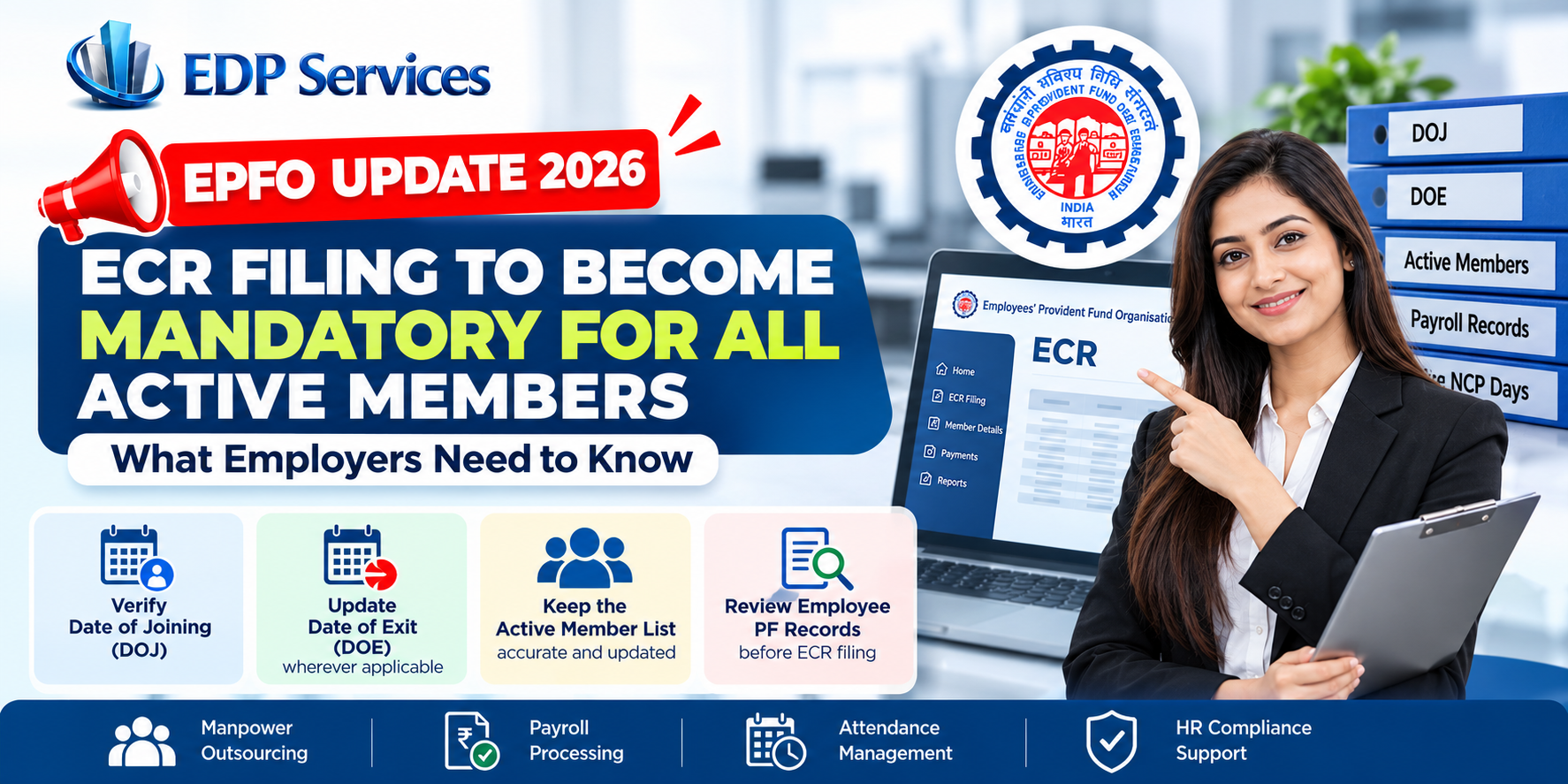
Stay informed about employer compliance requirements: Read our guide on EPFO ECR Filing for All Active Members to understand the announced ECR update and the importance of maintaining accurate employee records.
For professional support with payroll and workforce management, visit EDP Services.
Official References
Disclaimer: This article is intended for general informational purposes and is not legal, tax or financial advice. EPF contribution, withdrawal, pension and compliance provisions may change. Employers and employees should verify the latest official rules applicable to their circumstances before taking action.