
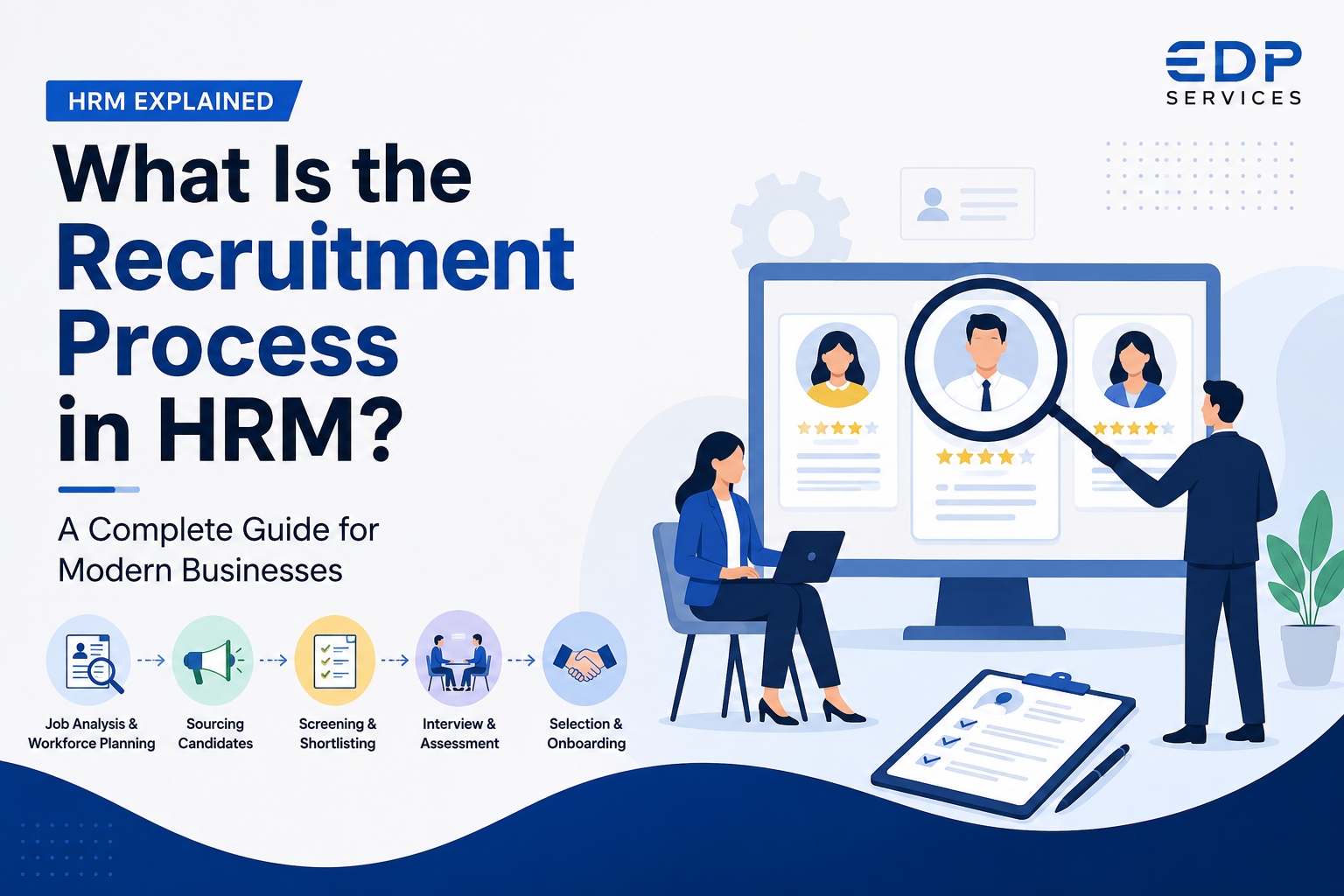
What Is the Recruitment Process in HRM? A Complete Guide for Modern Businesses
Recruitment is no longer just about filling vacant positions. In today's highly competitive business environment, hiring the right people has become a strategic business function that directly influences productivity, employee retention, customer satisfaction, and long-term organizational growth.
Whether a company is hiring a single specialist or expanding its workforce across multiple locations, every hiring decision impacts business performance. A delayed recruitment process can increase operational costs, overburden existing employees, and slow down business growth. On the other hand, a well-planned recruitment strategy helps organizations attract skilled professionals, reduce hiring risks, and build high-performing teams.
As industries continue to evolve, businesses are also facing new recruitment challenges, including skill shortages, changing employee expectations, remote hiring, and increasing compliance requirements. This is why many organizations partner with professional HR service providers like EDP Services to streamline recruitment, improve hiring efficiency, and ensure every recruitment decision supports business objectives.
This comprehensive guide explains everything you need to know about the recruitment process in Human Resource Management (HRM), its importance, each stage of recruitment, and how Recruitment Process Outsourcing (RPO) helps organizations hire better talent while reducing recruitment costs.
What Is Recruitment in Human Resource Management (HRM)?
Recruitment in Human Resource Management (HRM) is the structured process of identifying, attracting, evaluating, selecting, and hiring qualified candidates to fill job vacancies within an organization.
It serves as the foundation of workforce planning because every successful organization depends on having the right people in the right roles. Recruitment is not simply about advertising vacancies; it is about finding individuals whose skills, experience, values, and career aspirations align with the organization's goals.
A successful recruitment process ensures that businesses:
- Hire skilled professionals efficiently
- Reduce time-to-fill vacancies
- Improve employee retention
- Build stronger and more productive teams
- Strengthen employer branding
- Maintain compliance with employment regulations
- Support long-term business growth
Without a structured recruitment process, organizations often struggle with high employee turnover, increased hiring costs, poor workforce planning, and lower productivity.
Why Is Recruitment Important in Human Resource Management?
Recruitment is more than simply filling vacancies. It directly impacts business growth and long-term success.
An efficient recruitment process enables organizations to:
-
Find skilled professionals quickly
-
Reduce hiring mistakes
-
Improve workforce productivity
-
Strengthen organizational culture
-
Enhance employee engagement
-
Minimize recruitment expenses
-
Support future business expansion
The right employee contributes significantly to operational efficiency, innovation, customer satisfaction, and organizational performance.
What Is Recruitment Process Outsourcing (RPO)?
Recruitment Process Outsourcing (RPO) is a business model where an organization outsources all or part of its recruitment activities to a specialized recruitment partner.
Instead of managing hiring internally, companies collaborate with experienced HR service providers like EDP Services, who manage recruitment from job planning to employee onboarding.
An RPO provider becomes an extension of your HR department while bringing industry expertise, recruitment technology, and extensive talent networks.
Why Recruitment Is More Important Than Ever?
The job market has changed significantly over the past decade. Candidates now have more employment options, while employers face greater competition in attracting experienced professionals.
Recruitment has therefore become a strategic investment rather than an administrative function.
For example, imagine a growing manufacturing company planning to expand its operations into three new cities. Recruiting employees without a proper strategy may result in hiring delays, skill mismatches, and increased operational costs. However, a structured recruitment process allows the company to forecast hiring needs, source qualified candidates, conduct standardized evaluations, and onboard employees efficiently.
Organizations that invest in professional recruitment practices typically experience:
- Faster hiring cycles
- Better employee performance
- Higher workforce stability
- Lower recruitment costs
- Improved candidate experience
- Stronger employer reputation
- Better compliance with labour regulations
Recruitment directly contributes to organizational success because every employee influences customer experience, operational efficiency, innovation, and business growth.
Complete Recruitment Process in HRM
A successful recruitment process consists of several interconnected stages.
Step 1: Job Analysis and Workforce Planning
Everything begins with understanding the hiring requirement.
Job analysis involves identifying:
-
Responsibilities
-
Daily tasks
-
Required qualifications
-
Technical skills
-
Experience level
-
Reporting structure
-
Salary range
-
Performance expectations
This information is used to prepare a detailed job description that attracts suitable candidates.
Benefits
-
Defines hiring expectations
-
Reduces hiring errors
-
Attracts qualified candidates
-
Improves recruitment efficiency
Step 2: Job Description and Job Specification
After job analysis, HR creates two important documents:
Job Description
Describes:
-
Job title
-
Key responsibilities
-
Department
-
Working hours
-
Salary package
-
Reporting manager
Job Specification
Defines:
-
Educational qualifications
-
Technical skills
-
Certifications
-
Experience
-
Soft skills
-
Personality traits
Clear documentation improves candidate quality and reduces mismatched applications.
Step 3: Candidate Sourcing
Once the job is finalized, recruiters begin searching for suitable candidates.
Popular sourcing channels include:
Online Job Portals
Platforms such as:
-
Naukri
-
Indeed
-
Foundit
-
LinkedIn Jobs
Employee Referrals
Existing employees recommend qualified candidates.
Company Career Website
Many professionals directly apply through the company website.
Recruitment Agencies
Professional recruitment firms maintain extensive talent databases for faster hiring.
Social Media Recruitment
LinkedIn, Facebook, Instagram, and X (formerly Twitter) are increasingly used for employer branding and recruitment.
Campus Recruitment
Organizations hire fresh graduates directly from colleges and universities.
Using multiple sourcing channels increases the chances of hiring top talent.
Step 4: Resume Screening
Recruiters review applications to shortlist suitable candidates.
During resume screening, HR evaluates:
-
Education
-
Experience
-
Relevant skills
-
Industry background
-
Certifications
-
Career progression
-
Employment stability
Modern organizations often use Applicant Tracking Systems (ATS) to filter resumes efficiently.
This stage eliminates unsuitable applicants before interviews begin.
Step 5: Initial Candidate Screening
Before scheduling interviews, recruiters conduct preliminary discussions through:
-
Telephone interviews
-
Video calls
-
Virtual meetings
The objective is to verify:
-
Candidate interest
-
Salary expectations
-
Notice period
-
Communication skills
-
Basic technical knowledge
-
Job suitability
Only qualified candidates proceed to the next stage.
Step 6: Interviews and Assessments
This is one of the most critical stages in recruitment.
Organizations may conduct multiple interview rounds.
These can include:
HR Interview
Evaluates:
-
Communication
-
Career goals
-
Personality
-
Organizational fit
Technical Interview
Tests:
-
Subject knowledge
-
Practical skills
-
Problem-solving abilities
Managerial Interview
Assesses:
-
Leadership potential
-
Decision-making
-
Team collaboration
-
Business understanding
Skill Assessments
Companies may also conduct:
-
Aptitude tests
-
Coding assessments
-
Writing tests
-
Excel tests
-
Case studies
-
Role-specific evaluations
Step 7: Candidate Evaluation
After interviews, HR compares shortlisted candidates using structured evaluation criteria.
Evaluation factors include:
-
Technical expertise
-
Experience
-
Behavioral competencies
-
Cultural fit
-
Leadership potential
-
Learning ability
-
Salary expectations
Reference verification and background checks are usually completed during this stage.
Step 8: Background Verification
Background verification helps organizations reduce hiring risks.
Verification typically includes:
-
Employment history
-
Educational qualifications
-
Identity verification
-
Criminal record (where applicable)
-
Professional references
This step ensures recruitment transparency and compliance.
Step 9: Job Offer
After selecting the best candidate, HR issues an official offer letter.
The offer generally includes:
-
Job designation
-
Compensation structure
-
Benefits
-
Reporting location
-
Joining date
-
Employment terms
-
Probation period
Salary negotiation may also occur before final acceptance.
Step 10: Employee Onboarding
Recruitment does not end with offer acceptance.
Effective onboarding improves employee engagement and retention.
Typical onboarding activities include:
Documentation
-
Identity verification
-
Educational certificates
-
Tax documents
-
Bank details
Orientation
Employees learn about:
-
Company culture
-
Policies
-
Code of conduct
-
Organizational structure
Training
New employees receive:
-
Technical training
-
Process training
-
Compliance training
-
Safety training
Team Introduction
Employees meet:
-
Managers
-
Team members
-
HR representatives
-
Cross-functional teams
A structured onboarding experience helps employees become productive much faster.
Common Recruitment Challenges
Many organizations struggle with recruitment due to:
-
Talent shortages
-
High competition
-
Long hiring cycles
-
Poor candidate experience
-
Budget limitations
-
Skill gaps
-
High employee turnover
Working with an experienced recruitment partner helps businesses overcome these challenges efficiently.
Benefits of Recruitment Process Outsourcing (RPO)
Partnering with an experienced RPO provider like EDP Services offers several advantages.
Faster Hiring
Dedicated recruiters reduce time-to-hire.
Cost Savings
Organizations save on:
-
Recruitment advertising
-
Internal HR costs
-
Recruitment software
-
Hiring infrastructure
Better Candidate Quality
Specialized recruiters have access to larger and more qualified talent pools.
Scalable Recruitment
Businesses can easily scale hiring based on seasonal or business demands.
Compliance Support
RPO providers ensure recruitment complies with applicable labor laws and HR regulations.
Improved Candidate Experience
Professional communication throughout the hiring process strengthens employer branding.
Best Practices for an Effective Recruitment Process
To improve hiring success, organizations should:
-
Clearly define job requirements
-
Write compelling job descriptions
-
Use multiple sourcing channels
-
Adopt Applicant Tracking Systems (ATS)
-
Conduct structured interviews
-
Maintain transparent communication
-
Perform thorough background verification
-
Deliver a positive onboarding experience
-
Continuously measure recruitment performance
These practices significantly improve recruitment outcomes and employee retention.
Why Choose EDP Services for Recruitment?
At EDP Services, we help organizations simplify recruitment through professional, scalable, and technology-driven hiring solutions.
Our recruitment services include:
-
Recruitment Process Outsourcing (RPO)
-
Permanent Staffing
-
Executive Search
-
Bulk Hiring
-
Campus Recruitment
-
Payroll Support
-
HR Compliance Management
-
Employee Onboarding Assistance
With decades of HR expertise across multiple industries, we help businesses hire the right talent while reducing recruitment costs and improving operational efficiency.
Learn more about our Recruitment & HR solutions: EDP Services
You may also explore our HR Statutory Compliance Management Services to ensure your workforce remains fully compliant with Indian labor regulations:
Frequently Asked Questions (FAQs)
What is the recruitment process in HRM?
The recruitment process in HRM is a structured method of identifying, attracting, selecting, hiring, and onboarding qualified candidates to meet an organization's workforce requirements.
What are the main stages of recruitment?
The major stages include:
-
Job analysis
-
Job description
-
Candidate sourcing
-
Resume screening
-
Interviews
-
Candidate assessment
-
Background verification
-
Job offer
-
Onboarding
Why is recruitment important?
Recruitment helps organizations hire qualified employees, improve productivity, reduce turnover, and support long-term business growth.
What is Recruitment Process Outsourcing (RPO)?
Recruitment Process Outsourcing (RPO) is when a business delegates recruitment activities to an external HR specialist that manages hiring on behalf of the organization.
How does onboarding improve employee retention?
A structured onboarding process helps new employees understand company culture, expectations, and workflows, leading to higher engagement, faster productivity, and better retention.
Conclusion
An effective recruitment process is the foundation of a successful organization. From workforce planning and candidate sourcing to interviews, onboarding, and retention, every stage contributes to building a skilled and motivated workforce.
As hiring becomes increasingly competitive, partnering with a trusted recruitment expert like EDP Services enables organizations to streamline recruitment, improve hiring quality, ensure compliance, and focus on strategic business growth.
Whether you need support with permanent hiring, Recruitment Process Outsourcing (RPO), payroll, or HR compliance, EDP Services delivers reliable, scalable, and customized HR solutions designed for modern businesses.