
Employee attendance might appear to be just a routine part of HR, but minor errors in attendance management can cause major challenges for a company. Poor attendance management can lead to inaccurate records, payroll delays, compliance concerns, and ineffective workforce planning.
If you manage a startup, small business, or large enterprise, you know that a dependable attendance solution is critical to ensuring productivity and staying on the right side of the law. In this post, Attendly will inform you about the top errors in attendance management and how they affect the growth of your business and how you can avoid making these mistakes.
Why Attendance Management Matters
A decent employee attendance management system allows business owners to track employees' work hours, overtime, leaves, and their productivity. It also facilitates timely and accurate payroll, statutory compliance, and enhanced workforce planning.
But attendance tracking is highly time-consuming, inaccurate, and relegated to old-school methods in many companies.
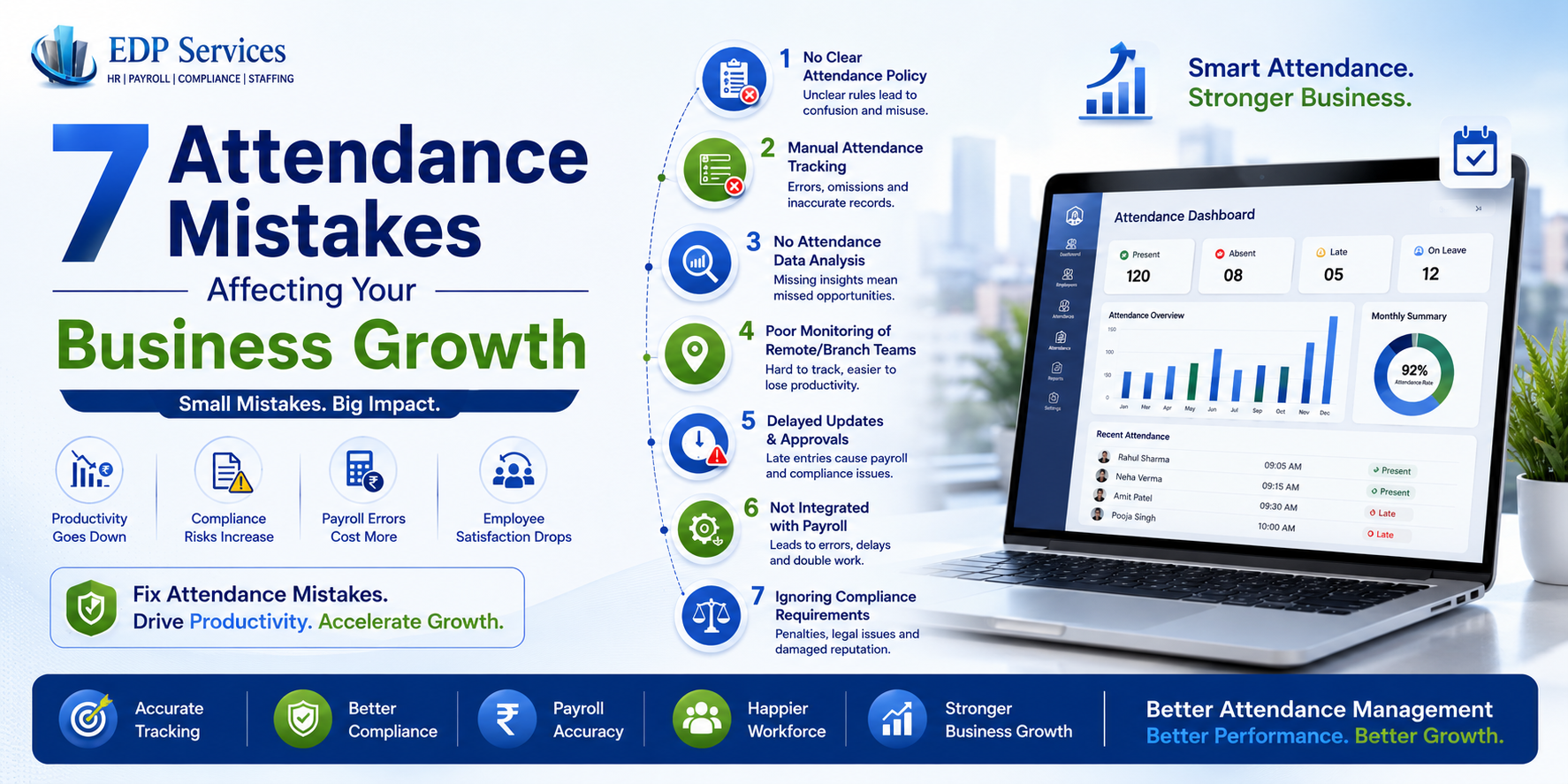
1. Using Manual Attendance Records
One of the worst attendance tracking errors is relying on paper registers or spreadsheets.
Manually tracking results in:
- Human mistakes
- Unrecorded attendances
- Payroll irregularities
- Troubles in the time of auditing.
Contemporary time and attendance management solutions automate attendance registration and enhance accuracy.
2. No clear employee attendance policy in place
Most companies never develop an employee attendance policy. The employees, without a clear policy in place, could have a misunderstanding of what the requirements are for working hours, leave application, overtime, late arrival, and absences.
A robust attendance policy must contain the following:
- Working hours
- Break timings
- Application for leave / Leave procedure
- Rules for late coming
- Policy in regard to working overtime
- Sanctions for attendance (if any)
Specific guidance reduces uncertainty and establishes uniformity within the company.
3. Attendance Data Analysis
Recording attendance alone is not enough.
Many companies collect attendance data but never analyze it. This is one of the most overlooked attendance management mistakes.
- Frequent absences
- Excess hours worked
- Shift coordination
- Productivity trends
- Staff shortages
HR staff can use the review of attendance records to make better business decisions.
4. A Lack of Monitoring of Employees's Attendance in Branches
Businesses with several branches or offices in different regions or countries often find it difficult to keep track of their employees.
In the absence of integrated attendance solutions, enterprises can face the following issues:
- Replicate records
- Incorrect working hours
- Reporting delays
- Errors in payroll
Cloud-based attendance systems simplify the process of monitoring employees in multiple locations and help organizations better manage time and attendance.
5. Delayed Update for Attendance
Another common attendance management mistake is updating attendance records days or weeks later.
Late updates often result in:
- Miscalculation of salary
- Errors in leave balance
- Unhappiness of employees
- Late payroll processing
Live attendance recording enables businesses to keep track of their employees accurately and run operations more efficiently.
6. Not Integrating Attendance with Payroll
Attendance and payroll need to be integrated always.
Complications such as the following frequently occur when attendance management is allowed to operate independently of payroll:
- Incorrect salary calculations
- Mistaken overtime pay
- Risk of non-compliance
- More paperwork
Integrating attendance with payroll systems helps reduce attendance errors while ensuring employees receive accurate salaries on time.
7. Ignoring Compliance Requirements
Many companies focus on just attendance-capturing and disregard the legal requirements concerning working hours, overtime, holidays, and employee records. Ignoring compliance may result in:
- Legal litigations
- Penalties from the government
- Employee dissatisfaction
- Audit failures
Businesses should regularly review their employee attendance policy to ensure it aligns with applicable labour laws and company regulations.
How to Reduce Attendance Errors
If you want to reduce attendance errors, follow these steps:
- Choose an automated biometrics or cloud-based attendance management system.
- Keep your employee attendance policy clear and current.
- Monitor attendance live.
- Conduct attendance audits periodically.
- Sync attendance to payroll software.
- Review attendance reports monthly.
- Provide training to HR teams for managing time and attendance effectively.
These processes enhance the efficiency of operation and reduce the risk of compliance.
Advantages of Improved Attendance Monitoring
Avoiding attendance management mistakes provides multiple business advantages:
- Payroll processing accuracy
- More employee accountability
- More effective workforce planning
- Decreased compliance risk
- Higher productivity
- Increased employee satisfaction
- Saves time for HR teams
A good attendance & time tracking system can boost your business growth by providing you with transparency through less paperwork.
How EDP Services Can Help
Tracking attendance by hand is a challenge that only grows when your workforce grows.
EDP Services provides intelligent HR and payroll services that make it easy to track employee attendance, manage time and attendance, and import attendance data straight into payroll.
Here’s how our solutions help businesses:
- Minimize attendance errors
- Enhance payroll accuracy
- Enhance compliance
- Centralize multiple locations
- Produce real-time attendance reports
With EDP Services, companies can automate attendance management, save precious HR time, and concentrate on enduring business growth.
Conclusion
Small errors in attendance management frequently go under the radar until they start impacting payroll, employee satisfaction, productivity, and compliance. With a well-defined employee attendance policy, trusted employee attendance monitoring software, and the latest time and attendance management solutions, organizations can minimize attendance related mistakes and increase operational efficiency.
Choosing the right attendance management system to invest in is an HR enhancement—but also a strategic business choice which supports sustainable growth, compliance and workforce productivity.