
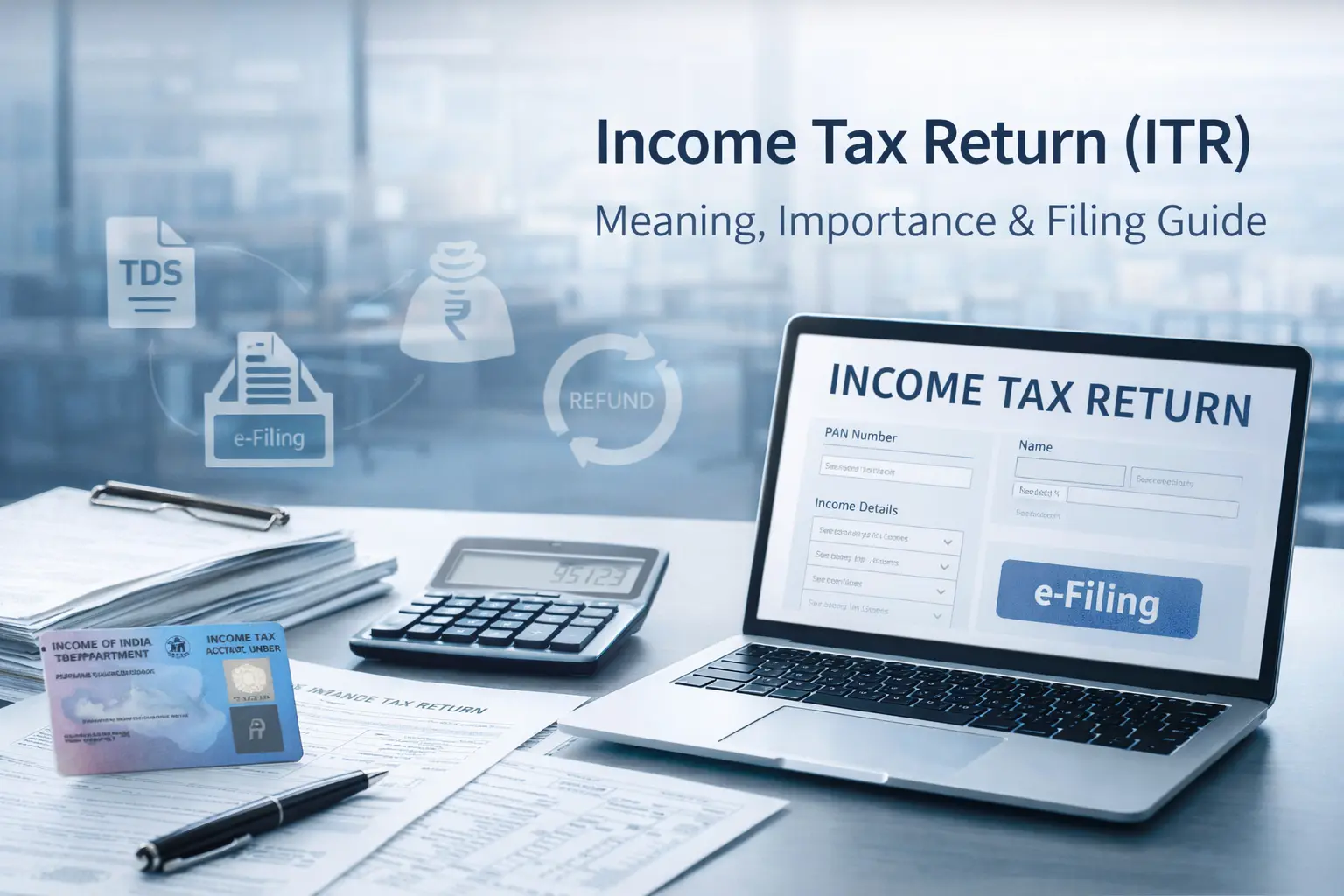
Income Tax Return (ITR) – Meaning, Importance & Filing Guide
An Income Tax Return (ITR) is a statutory document that must be sent to the Income Tax Department of India showing income, deductions and taxes for a financial year (April 1 – March 31). ITR also ensures compliance with the law, while retaining financial records and serving as proof of income for matters such as loans, visas, insurance statements, etc.
How to File ITR Online
The online option for filing your ITR is the most hassle-free as you can do it using the official website of the Income Tax Department. All that is required is an internet connection along with your login credentials (PAN and password) as well as the relevant ITR form.
Benefits of Filing ITR Online:
- Claim Refunds: In case your income falls under the taxable limit and TDS (Tax Deducted at Source) is charged, filing your ITR would help you to get refunds without delay.
- Proof of Income: For loans, visas, insurance and government schemes ITR is the official proof of income.
- Credit Eligibility: Banks and financial institutions can check for ITR documents to validate income and calculate which range of loan, credit card, or mortgage you would be eligible for.
- Compliance: Filing of the ITR is essential for compliance with the Income Tax Act and to avoid penalties or legal issues.
Which ITR Form Should You File?
Choosing the correct ITR form depends on your income sources and category:
- ITR 1: Individuals earning salary/pension, income from one house property, or other sources up to ₹50 lakh. (Not applicable for NRIs/HUFs)
- ITR 2: Individuals/HUFs with income from multiple sources excluding business/profession.
- ITR 3: Individuals/HUFs with income from business or professional sources.
- ITR 4: Individuals/HUFs/Firms (excluding LLP) with income up to ₹50 lakh from salary, house property, or presumptive business/professional income.
- ITR 5: Partnerships, LLPs, AOPs, BOIs, co-operative societies, estates, etc.
- ITR 6: Companies except those claiming Section 11 exemption.
- ITR 7: Charitable trusts, political parties, research associations, universities, and entities filing under sections 139(4A)–139(4F).
Why Should You File an Income Tax Return?
- To claim tax refunds from the government.
- To maintain proof of income for financial transactions such as loans, credit cards, and mortgages.
- To carry forward business, professional, or capital gains losses for future assessment years.
- To comply with legal obligations under the Income Tax Act.
- To provide official documentation for loans, visas, insurance, or government schemes.
Key Topics Related to ITR
- PAN: Permanent Account Number is mandatory for filing ITR.
- TDS: Tax Deducted at Source needs to be reflected in Form 26AS before filing ITR.
- E-Filing Portal: Official Income Tax Department portal for submitting ITR online.
- Tax Refund: Filing your ITR is required to claim refunds for excess tax paid.
- Income Documentation: ITR serves as proof of income for loans, visas, term insurance, and other purposes.
Need Expert Help Filing Your ITR?
Partner with EDP Services to file your Income Tax Return quickly and accurately. Our professionals ensure compliance, maximize your refunds, and provide guidance on PAN, TDS, and e-filing.
Frequently Asked Questions
Punch in your income, deductions and tax details on the “Annual Assessment Form” available after you register or log in to the Income Tax e-filing portal.
The Income Tax Return (ITR) filing deadline for FY 2022–23 (AY 2023–24) is July 31, 2023. Interest is chargeable under section 234A and a penalty under section 234F for late filing.
If the total income is above ₹5 lakh, penalty: ₹5,000; otherwise: ₹1,000. This penalty rises to ₹10,000 after 31st December 2023.
In fact, under Section 276CC of the Income Tax Act, non-filing can result in up to 6 months to 7 years' imprisonment.
We help you claim refunds, manage future losses and contribute towards your legal obligations through ITR filing.