
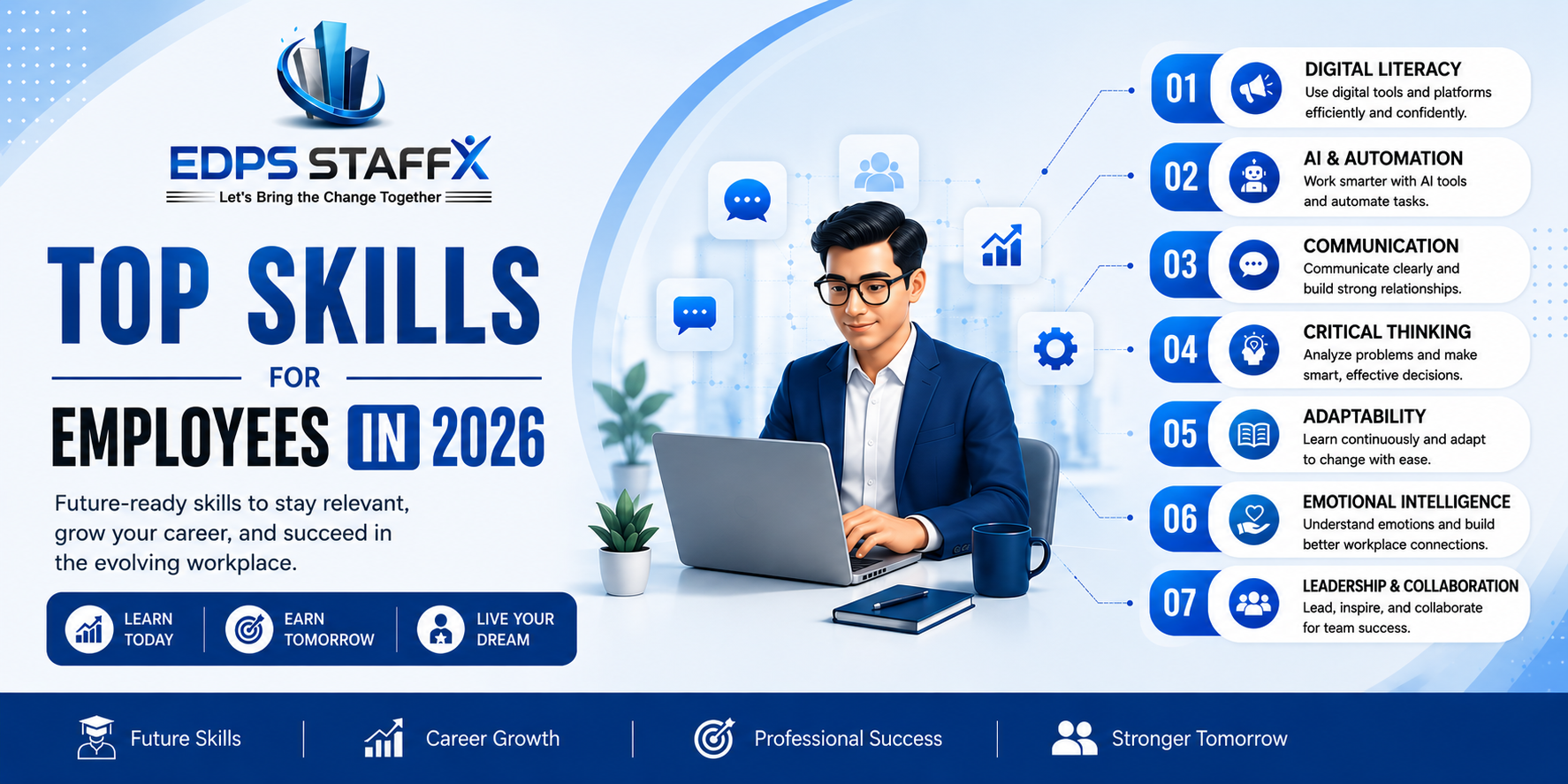
Top Skills for Employees in 2026
The office environment is evolving faster than ever. Artificial Intelligence (AI), automation, hybrid work, and digital transformation are redefining industries around the globe. As companies evolve with it, so too must their employees, who will need to acquire new skills if they want to avoid outdated skills and career irrelevance.
IT will need much more than technical expertise in 2026. Employers want people who are known for being able to problem-solve, communicate clearly, adapt to change, and feel comfortable using technology.
If you’re a student at university trying to get a head start, an experienced professional, or planning to change careers, upskilling with the Top 2026 Skills for Employees can increase your career prospects and success in the long term.
In this blog, we’ll identify the seven most important skills that every employee should upskill in order to remain future-ready.
Why Skills Matter More Than Degrees in 2026
More and more, employers today care about what their employees can do, not just what colleges they went to. Companies are banking on people who know how to continuously learn, adapt, and drive business growth.
Developing the right future skills for employees helps professionals:
-
Keep up with a changing job market
-
Advance in your career
-
Boost your efficiency
-
Sense of accomplishment
-
Adjust to changing technologies
-
Develop into key members of the team
Continuous learning has become a necessity rather than an option.
1. Digital Literacy and Technology Skills
Digital transformation has now reached virtually every sector. Workers use cloud platforms, collaboration tools, CRM software, HRMS solutions, AI assistants, and automation software.
What Strong Digital Employee Skills Include:
-
Utilizing workplace productivity tools
-
Understanding cloud-based applications
-
Handling digital communications
-
Basic cybersecurity awareness
-
Operating with AI-based software
Confidently Using Digital Technologies
Employees who are digital-savvy complete work quickly and mentally engage more in their work.
Why it matters
Companies have come to expect their staff to pick up new software and digital workflows on the fly, with little in the way of training.
2. AI and Automation Skills
Everyone talks about how artificial intelligence is changing everything—but past trends in tech show that such talk often outpaces reality. Human resources, finance, marketing, customer service, healthcare, logistics, and manufacturing—every one of them has AI tools.
Your employees don’t need to become AI engineers. Instead, they need to know:
-
How AI facilitates daily work
-
Writing productive prompts
-
Automating repetitive tasks
-
Using AI responsibly
-
Verifying AI-generated information
Developing the ability to work with AI on a job is one of the most in-demand skills for 2026.
Practical Examples
-
Drafting content using an AI tool
-
AI-enabled data analysis
-
Automatic report writing
-
AI recruitment tools
-
Smart scheduling assistants
3. Communication Skills
Technology is no substitute for good old human communication.
Employees who can clearly convey information are better able to connect with managers, clients, and teammates.
Critical communication skills are
-
Active listening
-
Professional email writing
-
Presentation skills
-
Verbal clarity
-
Providing and Receiving Feedback
Effective communication enhances collaboration, minimizes confusion, and maximizes productivity.
Tips to Improve
-
Practice public speaking
-
Keep your emails concise
-
Hear them out
-
Considerate inquiries
-
Tailor your communication to various audiences
4. Critical Thinking and Problem Solving
Modern organizations want their employees to address issues instead of bring them up for discussion.
Professionals who are skilled in critical thinking are able to:
-
Evaluate situations.
-
Use their good judgment
-
Recognize danger
-
Identify feasible alternatives
-
Enhance the way work is done
Instead of asking, "What should I do?" employers value people who ask, "Here are three possible solutions."
This way of thinking is ever more rising as one of the top skills for employees in 2026.
5. Adaptability and Continuous Learning
Change is the only constant in today's working environment.
New application software, regulations, business techniques, and consumer demands necessitate a continuously changing workforce.
Adaptable professionals frequently realize accelerated skill and career progression.
People can stay flexible by:
-
taking online courses
-
Keeping up with industry trends by reading
-
Mastering application software
-
Accepting constructive criticism
-
Obtaining additional certifications
It is the people that are willing to grow and not resist change that employers respect and value.
6. Emotional Intelligence
You need technical skills to get your foot in the door, but you need emotional intelligence to keep the door open.
Emotional intelligence is made up of:
-
Self-awareness
-
Compassion
-
Mental strength
-
Communication,
-
conflict resolution,
-
Relationship building
Employees with strong EQ create positive workplace environments and become effective leaders.
Advantages
-
More effective teamwork
-
Enhanced customer relationships
-
Higher employee satisfaction
-
Stronger leadership potential
-
Better stress management
As the work environment turns ever more team-oriented, emotional intelligence remains one of the most important future skills for employees.
7. Leadership and Collaboration Skills
Leadership and management are different.
All employees have the ability to show leadership by owning their work, helping their teammates, and gathering ideas.
Some key traits and skills of a strong leader include:
-
Responsibility
-
Decision-making
-
Collaborative work within a team
-
Time management
-
Initiative
-
Mentors others
Organizations are increasingly searching for individuals who are able to collaborate cross-functionally to achieve collective outcomes.
These are some of the most useful career growth skills, so for good, take them seriously.
How Employees Can Learn These Skills
You don't have to take pricey educations to acquire skills. You really can move the needle just by making small, steady improvements.
You can start by:
-
Taking professional online courses
-
Studying business and trade books
-
Practicing public speaking
-
familiarity with AI productivity tools
-
Studying Excel and data analysis
-
Working on actual business projects
-
Seeking feedback from managers
-
Taking webinars and seminars
Adding one new skill each quarter can markedly boost your career over time
Advantages of Striving to Acquire the Best Skills for the Workforce in 2026
Staff who tend to upskill themselves frequently enjoy the following:
-
Offer higher salaries.
-
Promoted at a faster pace
-
More confidence
-
More productive
-
Improved job security
-
Greater flexibility
-
More powerful professional reputation
Employers do, in fact, also profit from better-trained employees in terms of innovation, customer service, and business results.
Conclusion
The 2026 workplace will favor those professionals who have a blend of human and technical capabilities. Though artificial intelligence and automation may lead to the further disruption of industries, communication, emotional intelligence, adaptability, and leadership will continue to be irreplaceable human traits.
Building the top skills for employees in 2026 is not just about keeping your job now; it is also about future-proofing your career. By prioritizing lifelong learning, taking advantage of digital transformation, and enhancing their technical and people skills, employees can remain relevant in a dynamic job market.
Start developing these abilities today. The earlier you begin investing in your professional development, the more ready you will be for the future of work.