
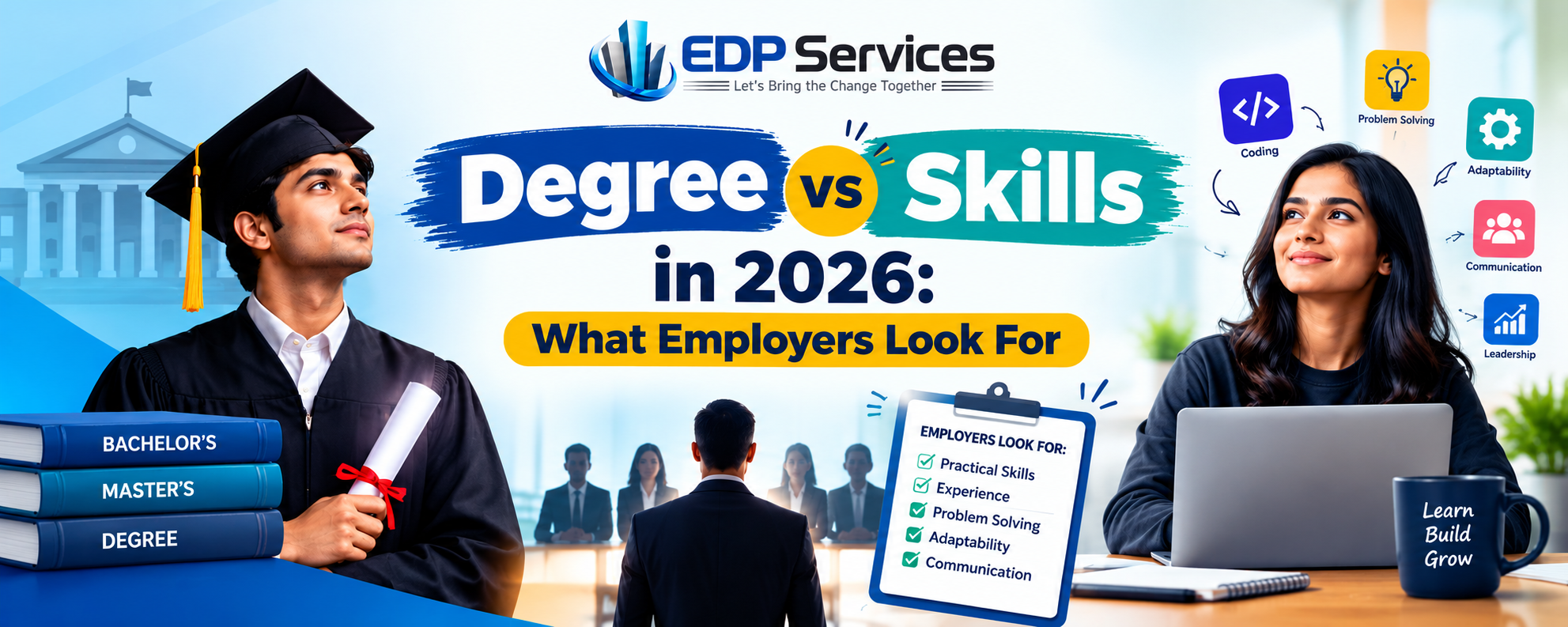
Degree vs Skills: What Do Employers Really Look For in 2026?
You cannot get a job just because you have a degree in today's highly competitive workplace. In today’s highly competitive workplace, a degree alone isn’t enough. Plenty of graduates around India finish their studies, but still struggling to find decent work because they have no practical experience, industry skills and communication skills, which have been lacking in this interview. Although, applicants who can show their expertise to organizations through projects, internships, and real-life experience may be favored in the hiring process.
Resultingly, graduate employers, degree vs. skills: which do you really seek in 2026?
The answer depends on the industry, job role and hires. Gain academic knowledge and demonstrate educational credentials, like an academic degree, but it's the skills that you use that bridge the skills gap that will truly convince the ideal employer. Knowing the industry's top needed skills for different roles enables freshers and seasoned professionals alike to enhance job prospects and gain a foothold into career advancement.
1. Degree vs Skills: What Matters More in 2026?
In the hiring process, degrees and actual skills serve different roles—neither one is automatically more important in every case.
A degree essentially offers theoretical knowledge, subject expertise, and a formal learning structure, it is also a legal requirement for some offices where you have to meet certain educational qualifications or licenses.
Skills tell you whether a candidate can does the required tasks, solve problems, and potentially add to an organization. These skills can be tested through interviews, practical tasks, work samples and previous experience.
For instance, a commerce graduate applying for an Accounting role needs an understanding of accounting concepts, as well as practical knowledge of how spreadsheets, financial records and accounting software function.
Likewise, a human resources graduate may gain advantage by learning about recruitment, staff documentation, attendance management and payroll processes.
For this reason, many organizations give weight to both qualifications and job-related capabilities when evaluating applicants.
2. Top Skills for High-Paying Jobs
Candidates should master skills pertaining to their profession. These skills are transferable across many areas (by categories).
A. Communication Skills
Communication is key to effective working with the managers, colleagues, clients and customers.
A good fit could also be a candidate who could be clear in talking, write in a professional manner, write emails, and be open when you are participating in discussions.
How to improve:
-
Practice speaking your mind in ideas in professional situations.
-
Learn to write clear and polite emails.
-
Participate in group discussions and presentations.
-
Develop interpersonal and listening skills.
Better communication enables candidates to do interviews better and work seamlessly when they come into an organization.
B. Technical and Digital Skills
Today, digital tools are common to large areas of the work place. Depending on the role, energy may be necessary from the candidate to know MS Excel, data entry, reporting software, digital collaboration platforms or industry specific business applications.
For example, administrative employees may use Excel to produce reports, access recruitment platforms, HR professionals often work with talent acquisition systems, attendance systems and payroll systems.
How to improve:
-
Identify the software that is frequently mentioned in the job descriptions.
-
Want to apply what you learn, and less concerned only with theory.
-
Practice creating spreadsheets, reports and presentations.
-
Become familiar with relevant digital and AI tools.
Candidates need not learn every tool on the market; they need to prioritize the tools that are part of their current career path.
C. Problem-Solving and Critical Thinking
Employers value employees that can analyze situations, identify errors and find practical solutions rather than asking for guidance at each step.
For instance, an administrative employee may have to point out a mistake in a report. An HR professional might have to look into an attendance discrepancy before paying out payroll.
How to improve:
-
Practice analyzing everyday workplace problems.
-
Split complicated tasks into smaller steps.
-
Take time to look at records before reaching a conclusion.
-
Earn calls to explain the thought process behind your solutions.
D. Teamwork and Adaptability
The majority of professions require interaction with other people. Employees have to coordinate teamwork, accept other viewpoints, adapt to rotating priorities, and respond as they grow.
Teamwork, responsibility, time management, and flexibility are all professional competencies that will accelerate your career aspirations.
Campus projects, internships, volunteering, and previous employment are all examples of where candidates can showcase these attributes.
E. Time Management and Attention to Detail
Time management and accuracy are critical to success in documentation-based, recruitment coordination, reporting, payroll, and compliance-related roles.
Minor mistakes in employee records or salary calculations can end up being expensive problems for businesses. Candidates that adhere to the processes above and orchestrate their projects in an organised manner can improve operations.
3. Why Are Practical Skills for Jobs Important?
Practical skills for jobs show how effectively a candidate can apply knowledge to real tasks. Academic qualifications may demonstrate what someone has studied, but practical experience can provide evidence of what they can do.
Candidates can demonstrate their abilities through:
-
Internships: Gain exposure to actual workplace responsibilities.
-
Academic projects: Apply theoretical knowledge to practical assignments.
-
Online courses: Build job-related knowledge through exercises and projects.
-
Volunteer work: Develop teamwork, organization, and communication.
-
Work samples: Present relevant projects, reports or portfolios.
-
Entry-level experience: Learn workplace processes and professional expectations.
For instance, a fresher interested in recruitment can practise screening sample resumes, preparing interview questions and maintaining a candidate-tracking spreadsheet.
These activities help candidates explain their abilities with specific examples during interviews.
4. How to Improve Job Skills Before Applying
Knowing how to improve job skills can help candidates prepare more effectively for employment opportunities.
Follow these practical steps:
-
Choose a target job role: Decide whether you want to work in HR, administration, finance, sales, IT or another field.
-
Study job descriptions: Identify the qualifications, technical abilities and soft skills employers commonly request.
-
Assess your skill gaps: Compare your existing abilities with the requirements of your target role.
-
Create a learning plan: Select relevant courses, tools and practical assignments.
-
Build demonstrable experience: Complete projects or internships that allow you to apply what you have learned.
-
Update your resume: Highlight relevant skills, projects, achievements and experience honestly.
-
Prepare for interviews: Practice explaining how you have used your skills to complete tasks or solve problems.
-
Continue learning: Review your progress regularly and update your skills as job requirements change.
These career skills for freshers can also help experienced professionals prepare for promotions, career changes, and new responsibilities.
5. What Is Skill-Based Hiring?
Skill-based hiring is a talent acquisition model that evaluates candidates based on the skills required to be successful in the role, instead of using just degrees or educational background.
In many cases, this will include, but not limit to, practical tests, structured interviews, work samples, technical assessments, and questions around previous experiences.
Imagine a candidate applying for a data-related position they could be asked to perform an Excel task. If the position is customer-facing, the candidate will be judged on communication and problem-solving.
Skill-based hiring, however, is not synonymous with unqualified hiring. Functional managers and hiring teams must take into consideration mandatory and relevant experience and specific job responsibilities of a position.
For candidates, you can only improve if you know the role requirements and can prove you have the needed competencies.
6. How EDP Services Provides Solutions for Business Workforce Needs
Meeting the needs of candidates whose profile aligns with the onshore entity a company which they represent is critical in workforce management for businesses and they need staff with the relevant education, skill set, and knowledge to perform and positions.
EDP Services provides business workforce solutions, such as manpower outsourcing, recruitment services, payroll services, time and attendance management, and compliance support.
These services assist businesses in meeting staffing and workforce administration needs. Companies can learn more workforce support by looking into recruitment services and manpower outsourcing solutions.
For candidates, they can be better prepared for the right opportunities by having a clear understanding of the expectations of employers and continuously building career related skills.
Frequently Asked Questions (FAQs)
1. Are skills more important than a degree in 2026?
It depends on the job. Some positions require specific qualifications, while others place greater emphasis on practical abilities and experience. Many employers consider both.
2. What are the top skills for jobs in 2026?
Communication, problem-solving, digital literacy, teamwork, adaptability and role-specific technical knowledge are useful across many professions.
3. Can freshers get jobs without work experience?
Yes, depending on the role and its requirements. Internships, academic projects, certifications and practical assignments can help freshers demonstrate their abilities.
4. How can I develop professional skills for career growth?
Set clear career goals, practise relevant skills, seek feedback, complete practical projects and continue learning throughout your career.
5. What do employers look for besides a degree?
Employers may consider practical knowledge, communication, problem-solving, relevant experience, adaptability and the ability to perform the responsibilities of the role.
Conclusion
The degree vs skills debate is not about choosing one over the other. A degree can provide essential knowledge, while practical skills demonstrate how effectively a candidate can apply that knowledge in the workplace.
For job seekers, the best strategy is to combine relevant qualifications with hands-on learning, communication, technical knowledge and continuous improvement. Focusing on the top skills for jobs can help candidates prepare for changing workplace expectations and improve their employability.
For employers, evaluating qualifications alongside job-related abilities can support more informed recruitment decisions.
In 2026, building the right combination of education, practical experience, and professional skills is a valuable step towards long-term career success.