
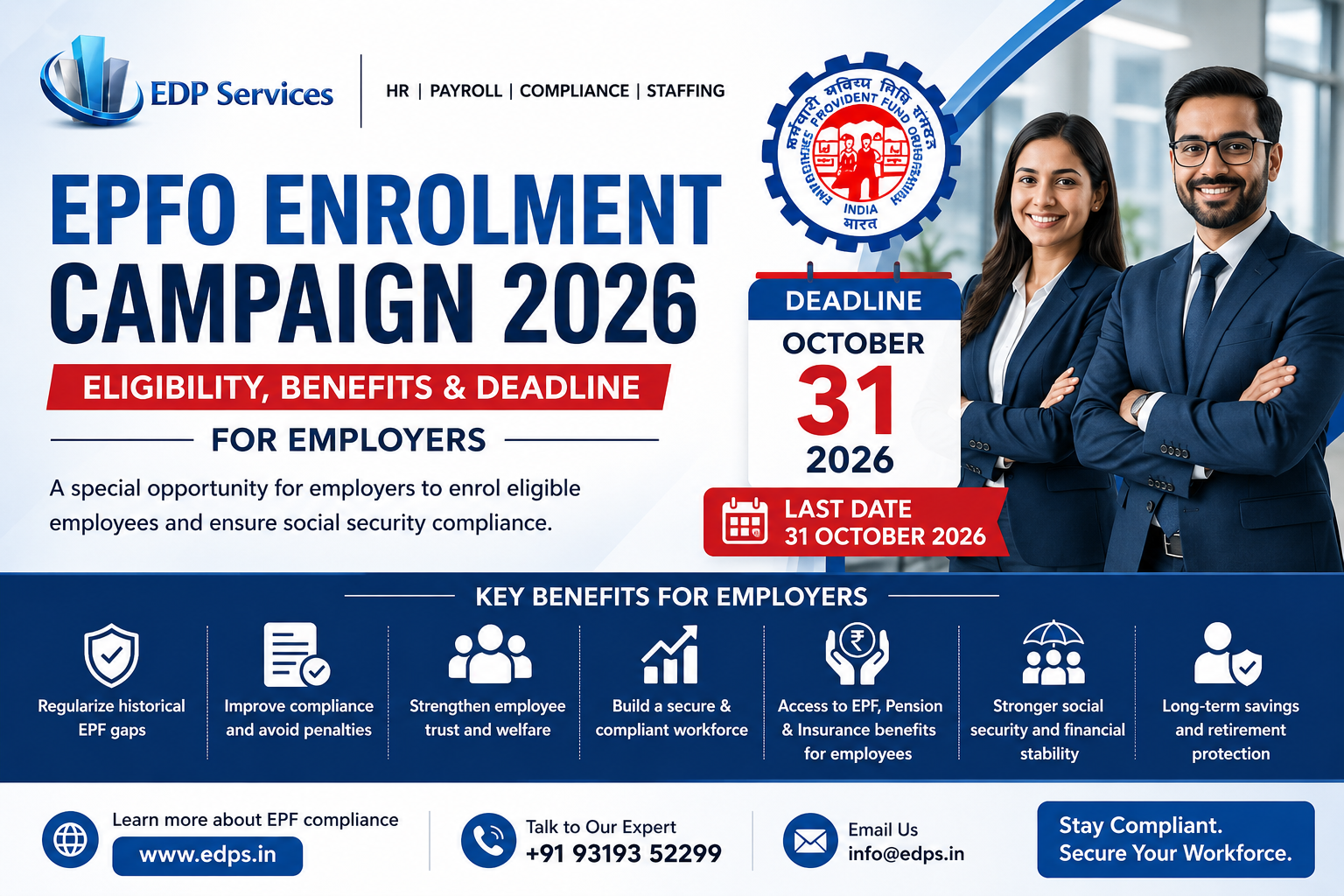
EPFO Enrolment Campaign 2026 is a significant compliance update for Indian employers & employees. The Employees’ Provident Fund Organisation (EPFO) has introduced a special, one-time opportunity for employers to enrol eligible employees who were left outside EPF coverage during the specified historical period.
This open campaign will close on 31 October 2026. This includes eligible employees who were not covered by EPF between 1 April 2009 and 31 March 2026, subject to the campaign’s conditions.
For HR teams, business owners, and recruiters, this is more than an administrative update. It’s an opportunity to audit employee records, plug historic gaps in enrolment, and strengthen statutory compliance.” For workers, from veterans to those in the workforce, it can mean access to critical social security benefits.
What Is the EPFO Enrolment Campaign 2026?
The Employees’ Enrolment Campaign (EEC) 2026 is a special compliance window introduced by EPFO to allow eligible establishments to voluntarily enrol workers who should have been covered under EPF but were left out.
The campaign became operational from 1 July 2026 and is available until 31 October 2026. The government has specifically encouraged establishments to use the window before it closes.
Importantly, this is not a general registration facility for every former employee. The employee must satisfy the campaign conditions, including being alive and continuing in employment with the establishment on the date of declaration.
Who Can Benefit From EEC 2026?
Participants in the campaign are defined as employers and employees who meet the eligibility criteria that have been established.
|
Employer / Employee Situation |
EEC 2026 Relevance |
|
Eligible employee left outside EPF coverage. |
Potentially eligible |
|
The employee was covered correctly from the beginning. |
No historical enrolment gap |
|
Eligible employee still working with the establishment |
Potentially eligible, subject to conditions |
|
Former employee who has already left |
Generally outside the stated campaign condition |
|
Startup or SME with historical EPF gaps |
Should review records |
|
Large employer with multiple locations |
Should conduct a location-wise review |
The key period to investigate is 1 April 2009 to 31 March 2026. Employers should not assume that every employee from this period qualifies; eligibility needs to be checked against the applicable EPF rules and campaign conditions.
What Are the Benefits for Employers?
For employers, the biggest advantage is the opportunity to address certain historical enrolment gaps through a defined voluntary compliance mechanism.
Under the campaign, where the employee’s share was not deducted from wages earlier, that employee contribution is waived under the specified conditions. The employer is required to pay the employer’s share along with applicable interest and administrative charges. A lump-sum damages amount of ₹100 is also specified under the campaign.
This can help businesses:
-
Identify and regularise eligible historical EPF gaps.
-
Improve statutory compliance records.
-
Reduce uncertainty around previously missed enrolments.
-
Strengthen employee social-security coverage.
-
Create more organised payroll and employee records.
-
Demonstrate a proactive approach to compliance.
Looking at payroll records from the past can help small and medium-sized businesses, and especially startups, avoid larger compliance headaches down the road today. This is especially true for startups.
What Does It Mean for Employees and Job Seekers?
Employees covered through the EPF framework can receive important social-security benefits, including provident fund, pension and insurance-related protection, subject to applicable rules. EPFO has specifically described EEC 2026 as a way to extend these benefits to workers who remained outside EPF coverage.
However, job seekers should understand an important limitation: EEC 2026 is not a scheme through which an unemployed person or a former employee can independently apply for EPF coverage.
The campaign concerns eligible employees who meet the prescribed conditions and are continuing in employment with the establishment when the declaration is made. Therefore, freshers and experienced professionals joining a new employer should focus on understanding their normal EPF eligibility and ensuring that their employer handles onboarding and statutory deductions correctly.
What Should HR Teams Do Before October 31?
HR professionals and payroll teams should avoid waiting until the final days.
A practical review can include:
-
Check historical employee records from 1 April 2009 onward.
-
Identify employees who may have been eligible but were not enrolled.
-
Verify employment and wage records.
-
Confirm whether the concerned employees are currently working with the establishment.
-
Review existing UAN and EPF records.
-
Validate payroll data against attendance and employee master records.
-
Complete declarations through the prescribed EPFO online process.
-
Generate Face Authentication-based UAN where required through the UMANG App.
-
Complete the required ECR-linked contribution process.
-
Maintain supporting documentation for future reference.
EPFO has indicated that the campaign uses an online process involving the employer portal, Face Authentication-based UAN generation, and ECR-linked TRRN filing.
Why Payroll Accuracy Matters
EPF compliance cannot be separated from payroll management. Employee classification, wages, joining dates, attendance records, deductions and statutory filings all need to work together.
For example, if an employee's joining date in the HR system differs from payroll records, or historical employee data is incomplete, identifying an EPF enrolment gap can become difficult.
That is why businesses should treat the EEC 2026 review as both a compliance exercise and a payroll-data audit.
EEC 2026: Key Dates at a Glance
-
Eligibility period: 1 April 2009 to 31 March 2026
-
Campaign operational period: 1 July 2026 to 31 October 2026
-
Final deadline: 31 October 2026
-
Nature: Special one-time enrolment opportunity
-
Primary responsibility: Employer
-
Employee status: Must meet campaign conditions, including continuing employment at declaration
EPFO has urged eligible establishments to complete enrolment before the campaign closes on 31 October 2026.
How EDP Services Can Help
Managing EPF enrollment in addition to payroll, employee documentation, and other statutory requirements can be time-consuming for businesses.
EDP Services provides HR outsourcing and payroll management and statutory compliance support to businesses. This includes support in relation to PF, ESIC, payroll compliance, employee records, and HR documentation.
If your organization requires assistance with auditing payroll records, compliance gaps, or ongoing HR and statutory processes, EDP Services’ HR Statutory Compliance Management Services may be of interest.
Need professional HR and payroll compliance support?
Explore EDP Services
Conclusion
The EPFO Enrolment Campaign 2026 gives eligible employers a limited opportunity to address historical EPF enrolment gaps and extend social-security coverage to qualifying employees. With the deadline set for 31 October 2026, HR and payroll teams should begin reviewing their records rather than waiting until the final week.
The campaign stresses the need for employees to have adequate EPF coverage and correct employment records. For employers, it is a timely reminder that payroll accuracy and statutory compliance must go hand in hand.
If your business is uncertain about its EPF records, eligibility assessment, or wider payroll compliance needs, professional HR compliance support can help to structure and enhance the reliability of the review.
Important: This article is based on the latest official government/EPFO information available as of 24 August 2026. Employers should verify the detailed campaign conditions and latest instructions on the official EPFO portal before submitting a declaration.
Frequently Asked Questions
It is a special one-time opportunity allowing employers to voluntarily enrol eligible employees who were left outside EPF coverage during the specified period, subject to campaign conditions.
The campaign is open until 31 October 2026. Employers should complete the required process before the deadline.
The campaign covers eligible employees left outside EPF coverage between 1 April 2009 and 31 March 2026, subject to the prescribed conditions.
The campaign requires the declared employee to be alive and continuing in employment with the establishment on the date of declaration. Therefore, employers should verify eligibility rather than assuming former employees qualify.
Where the employee's share was not deducted from wages earlier, it is waived under the specified campaign conditions. Employers remain responsible for the applicable employer contribution, interest, and administrative charges.
Yes, establishments that are covered or coverable under the applicable EPF framework should review their records and determine whether they have eligible employees who were left outside coverage.
The campaign provides an online process through the EPFO Employer Portal, including prescribed declaration, Face Authentication-based UAN generation through UMANG and ECR-linked contribution filing.
Employers should review historical employee and payroll records, identify potential gaps, verify eligibility, and complete the prescribed enrolment and contribution process well before 31 October 2026.